SAST False Positive Statistics 2026: 8 Numbers on the Noise Problem


In 2026 the average security team fields more alerts than it can read, let alone fix, and the large majority of the ones marked "critical" turn out not to be. The scanners are doing their job; there are just far more findings than any team can work. We pulled the numbers from this year's primary industry reports to size the false-positive problem and, more usefully, to show what actually cuts through it and where the teams pulling ahead are already winning.
Two things get lumped together as false positives. A true one is a finding that isn't real; most of what buries a team is different, real findings that aren't exploitable in their application. Both burn triage time, and both count as noise here. The figures span the scanner stack (SAST, SCA, and runtime), because that noise is a pipeline problem, not a single-tool one, with SAST the canonical case.
Key takeaways
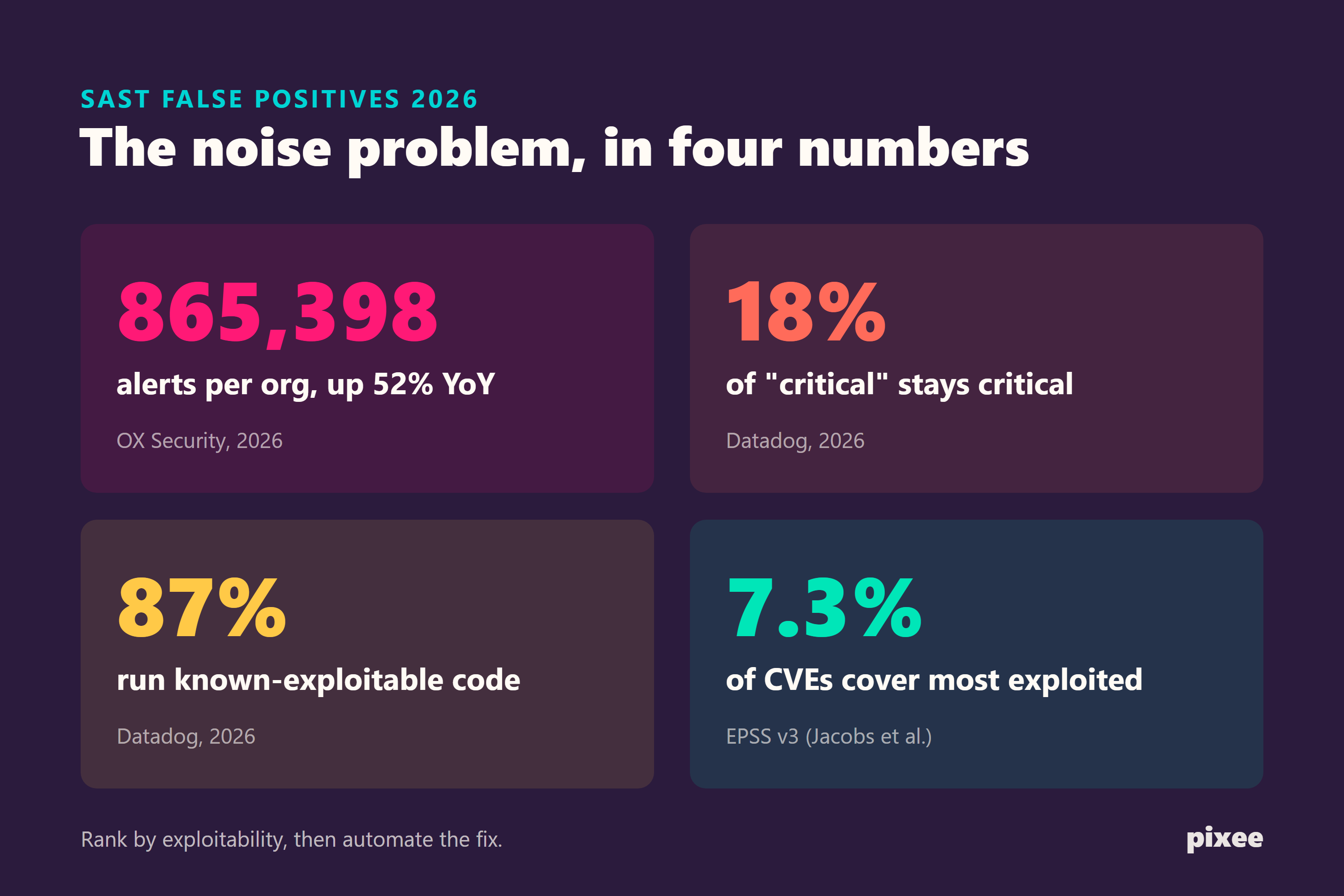
• Organizations now average 865,398 security alerts each, up 52% year over year (OX Security's 2026 Application Security Benchmark).
• Only 18% of vulnerabilities labeled critical stay critical once runtime context is applied (Datadog, 2026).
• 87% of organizations are running software with known exploitable vulnerabilities (Datadog, 2026).
• Remediating just 7.3% of known CVEs covers most of the vulnerabilities attackers actually exploit (EPSS v3 paper, Jacobs et al.).
The noise is drowning the signal
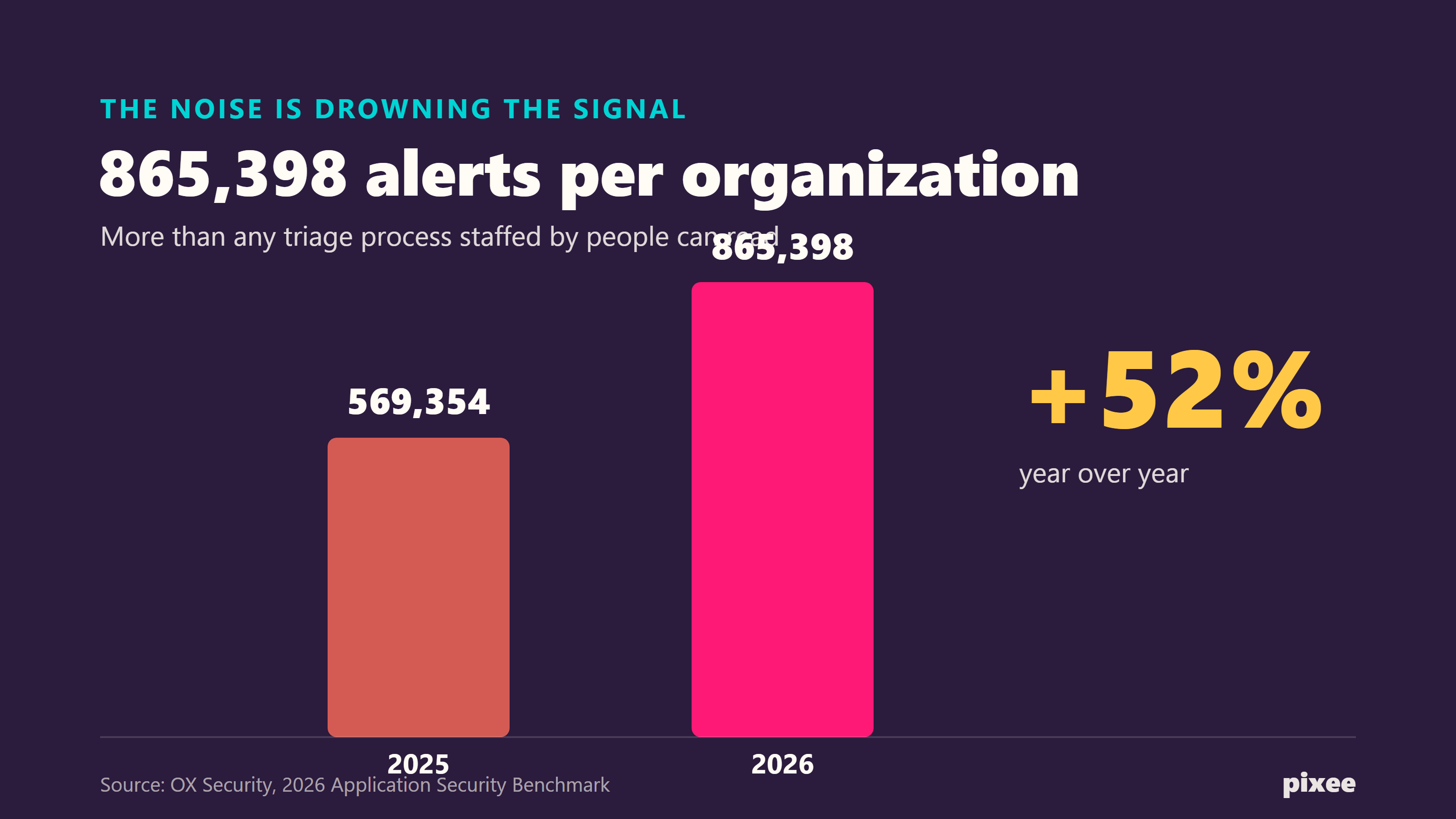
Before a single false positive is triaged, the raw volume already exceeds human capacity.
865,398. Organizations average 865,398 security alerts each, up 52% from 569,354 the prior year (OX Security's 2026 Application Security Benchmark). No triage process staffed by people keeps pace with that.
4x. Critical findings alone nearly quadrupled year over year, from 202 to 795 per organization (OX Security's 2026 Application Security Benchmark). When the "critical" bucket grows 4x, "critical" stops meaning urgent.
Pixee POV: Volume is why triage has to be automated before remediation even starts. Pixee's triage automation cuts false positives by up to 95% through exploitability analysis across 12 native scanner integrations, so the queue that reaches a human is the queue worth working, and its remediation automation then ships context-aware fixes at a 76% merge rate.
Most "critical" isn't
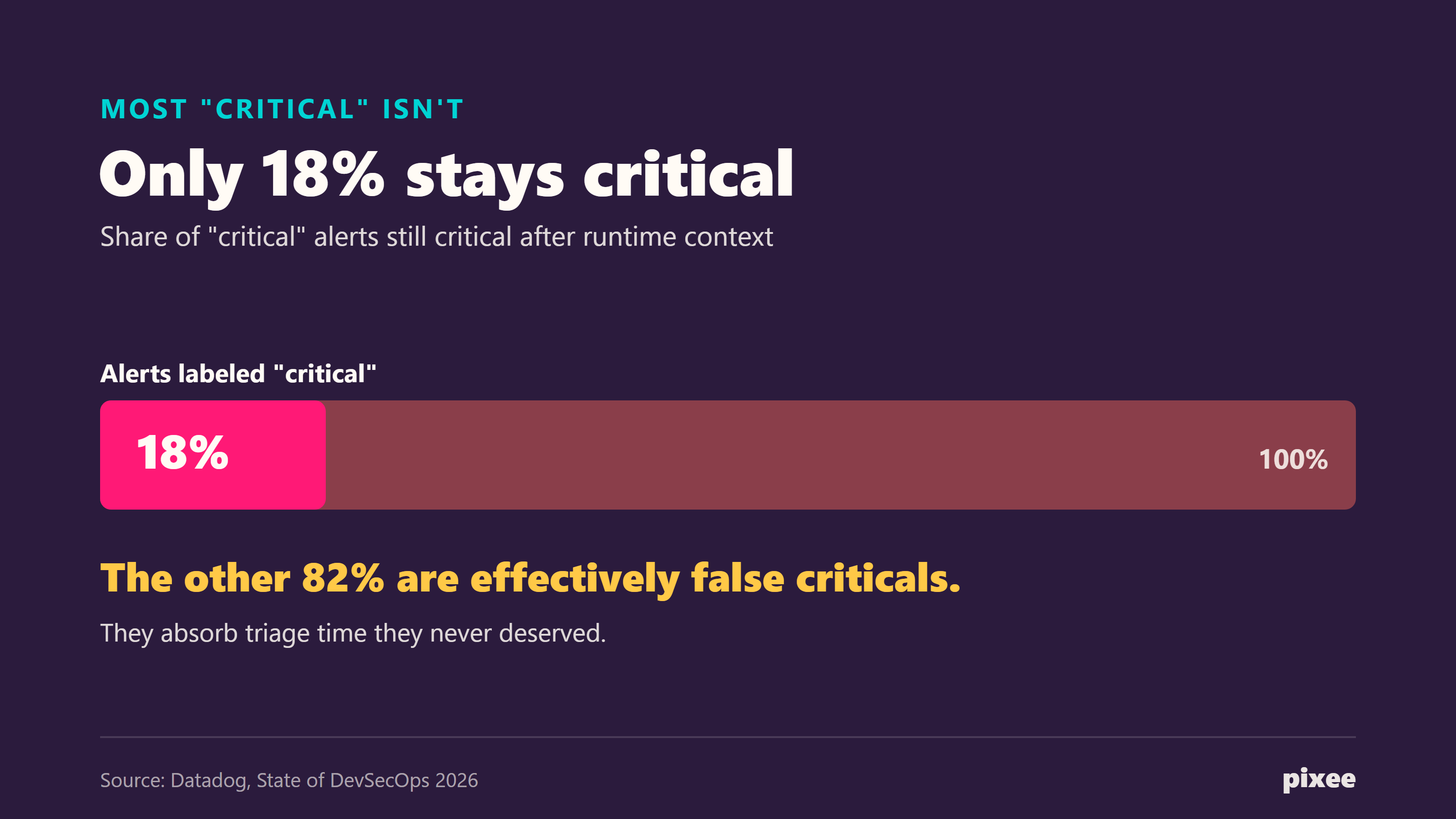
The reason alert volume is survivable is that most of it is noise, and the 2026 data quantifies exactly how much.
Only 18%. Just 18% of vulnerabilities labeled critical stay critical once runtime context is applied (Datadog, 2026). The other four in five are critical in name only, real findings whose urgency evaporates once exploitability is accounted for, and they absorb triage time they never deserved.
87%. Meanwhile, 87% of organizations are running software with known exploitable vulnerabilities (Datadog, 2026). The signal that matters is buried under the noise that doesn't.
50%. Half of services on end-of-life language versions carry exploitable vulnerabilities, versus 31% for supported versions (Datadog, 2026). Severity labels don't tell you what is actually at risk; runtime context does.
The cost of chasing false positives
The noise costs the time of the people you can least afford to waste.
25%. Security teams spend roughly a quarter of their time chasing false positives (The Truth About AppSec False Positives, 2020). That number was a warning six years ago; the alert volume above shows it went unheeded.
The ratio only worsens as volume climbs. When alert counts rise year over year while the genuinely critical findings stay a small fraction of the labeled ones, every added scanner and every new rule widens the gap between what a team is told to review and what actually matters. Accuracy tuning does not close that gap.
No scanner, on its own, knows whether a finding is reachable and exploitable in your specific application. That context lives outside the scanner, which is why the answer has to live there too, in a triage layer that reads the whole application rather than one file at a time.
What actually cuts the noise
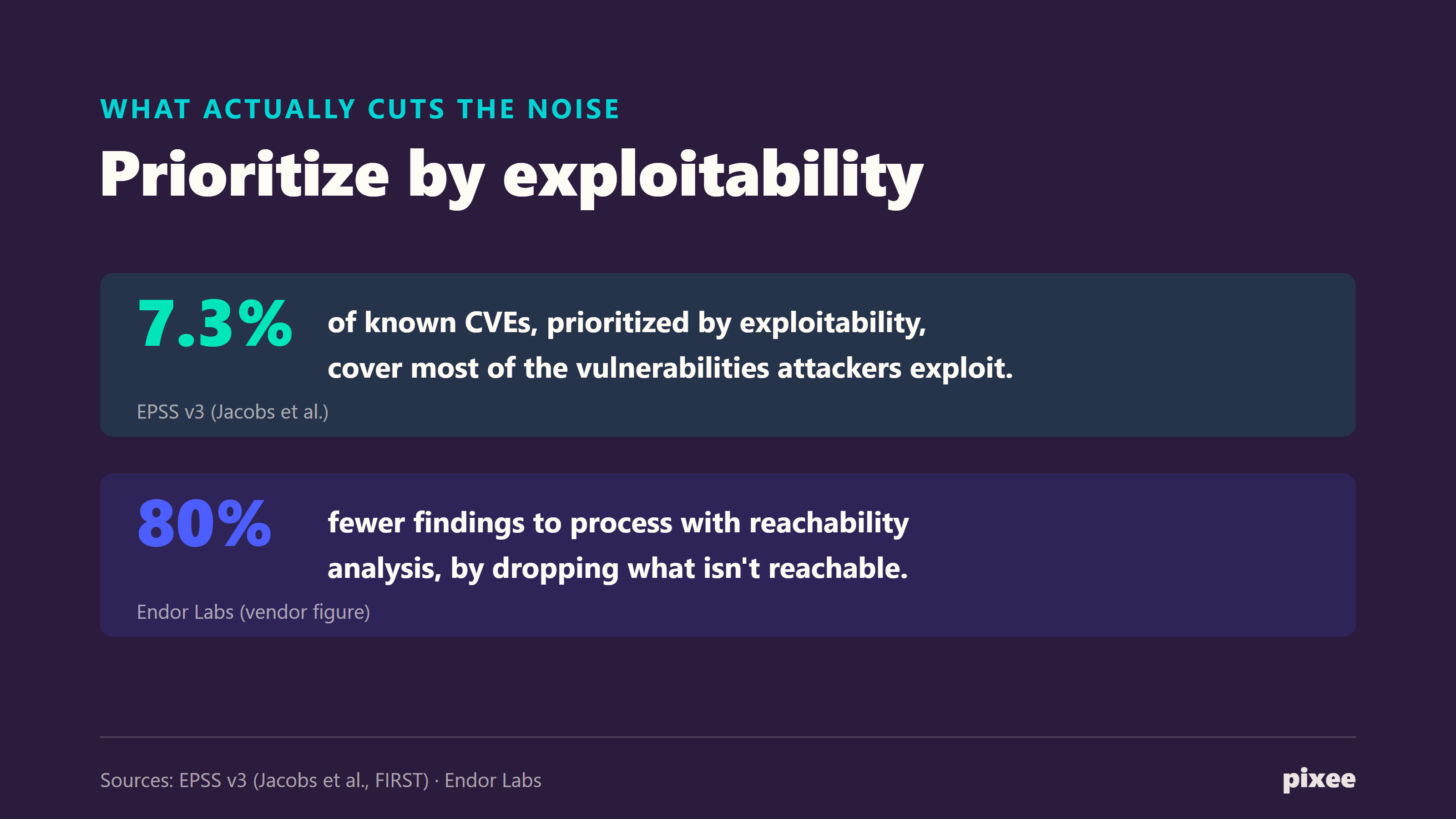
The teams pulling ahead do not scan less. They rank by exploitability first, then fix what survives.
7.3%. Remediating just 7.3% of known CVEs, those scoring above the EPSS 0.088 threshold, covers most of the vulnerabilities that actually get exploited (EPSS v3 paper, Jacobs et al.). The vast majority of the queue is deferrable noise.
80%. Reachability analysis cuts the findings a team has to process by about 80% by removing vulnerabilities that are not reachable in the running application (Endor Labs, vendor figure).
Pixee POV: This is the whole argument for a resolution layer over your scanners. Pixee triages first (up to 95% false-positive reduction via exploitability analysis), then remediates the survivors with context-aware fixes that match your code conventions, landing at a 76% merge rate and a 94% end-to-end resolution rate.
What these numbers mean for your team
Put together, the 2026 numbers point one way. The false-positive problem is one of volume and context: teams are handed hundreds of thousands of alerts, told most are critical, and left to discover by hand that only a fraction truly are.
The teams staying ahead invert the order. They let exploitability decide what reaches a human, then automate the fix so engineers approve merges instead of hand-writing patches.
If your team is drowning in scanner noise, a more accurate scanner won't dig you out. The fix is triage that separates the exploitable few from the deferrable many, paired with remediation that turns those findings into merged pull requests. See how Pixee automates both triage and remediation.
Frequently asked questions
What share of security alerts are false positives or low-priority noise in 2026? Only 18% of vulnerabilities labeled critical stay critical once runtime context is applied (Datadog, 2026), so roughly four in five "critical" alerts are either not real or not exploitable enough to earn the label. Volume compounds the problem, with organizations averaging 865,398 alerts each (OX Security's 2026 Application Security Benchmark).
How much time do security teams lose to false positives? Security teams spend about 25% of their time chasing false positives (The Truth About AppSec False Positives, 2020) — a cost that has only grown as alert volume rose 52% year over year (OX Security's 2026 Application Security Benchmark).
How do you reduce SAST false positives? Prioritize by exploitability, not severity label. Remediating just 7.3% of known CVEs covers most exploited vulnerabilities (EPSS v3 paper, Jacobs et al.), and reachability analysis removes about 80% of findings that are not reachable in production (Endor Labs, vendor figure).
Methodology & sources
Every statistic above is drawn from a primary industry report, cited inline with its source and year. Figures are quoted as the source states them, not aggregated into ranges.
• OX Security. 2026 Application Security Benchmark Report (216M+ findings across 250 organizations).
• Datadog. State of DevSecOps 2026.
• The Truth About AppSec False Positives (2020) — noted as a dated but still-cited baseline for false-positive time cost.
• Endor Labs. EPSS + Reachability Analysis, synthesizing the EPSS v3 paper (Jacobs et al., FIRST).
Pixee proof metrics (up to 95% false-positive reduction, 76% merge rate, 94% end-to-end resolution rate) are from Pixee's customer cohort, 2025.