Code-context analysis
Pixee reads what surrounds each finding (variable names, file paths, imports, config, data flow) and decides from that context whether it's a secret.
Most of what your secrets scanner flags isn't a secret. Regex can't tell a live key from a checksum. Pixee reads the code around each finding and tells you which are real, with the evidence. Your developers stop chasing false alarms.
A secrets scanner doesn't find secrets. It matches shapes. At one global bank the rules were three regexes: a password =-style assignment, a standard UUID, and a 64-character hex string meant to catch crypto-wallet private keys.
That's roughly 200 false alarms for every real secret. The team couldn't keep up.
It isn't one bank's problem. When researchers benchmarked nine secret-detection tools, five scored under 7% precision, tripping on placeholders, commit IDs and other long, random-looking strings. (Basak et al., 2023)
And one match hard-fails the build, so a developer with a perfectly safe change ships on another team's schedule.
Pixee runs the same checks a careful engineer would, on every finding, every time. No fresh guess from a chat prompt.
Pixee reads what surrounds each finding (variable names, file paths, imports, config, data flow) and decides from that context whether it's a secret.
Every finding starts from a curated catalog of the usual false alarms: analytics IDs, Sentry DSNs, publishable keys, placeholders like changeme, and the pk_-vs-sk_ convention.
A secret or a field name? Test code? A client-side token? Localhost only? A real secret in a test still flags, at lower severity.
Point Pixee at a rule it has never seen. It works out the finding type from rule metadata, CWE tags and code context. No pattern tuning.
Every verdict, whether true positive, false positive or inconclusive, carries its reasoning, so your team reviews a rationale instead of a binary.
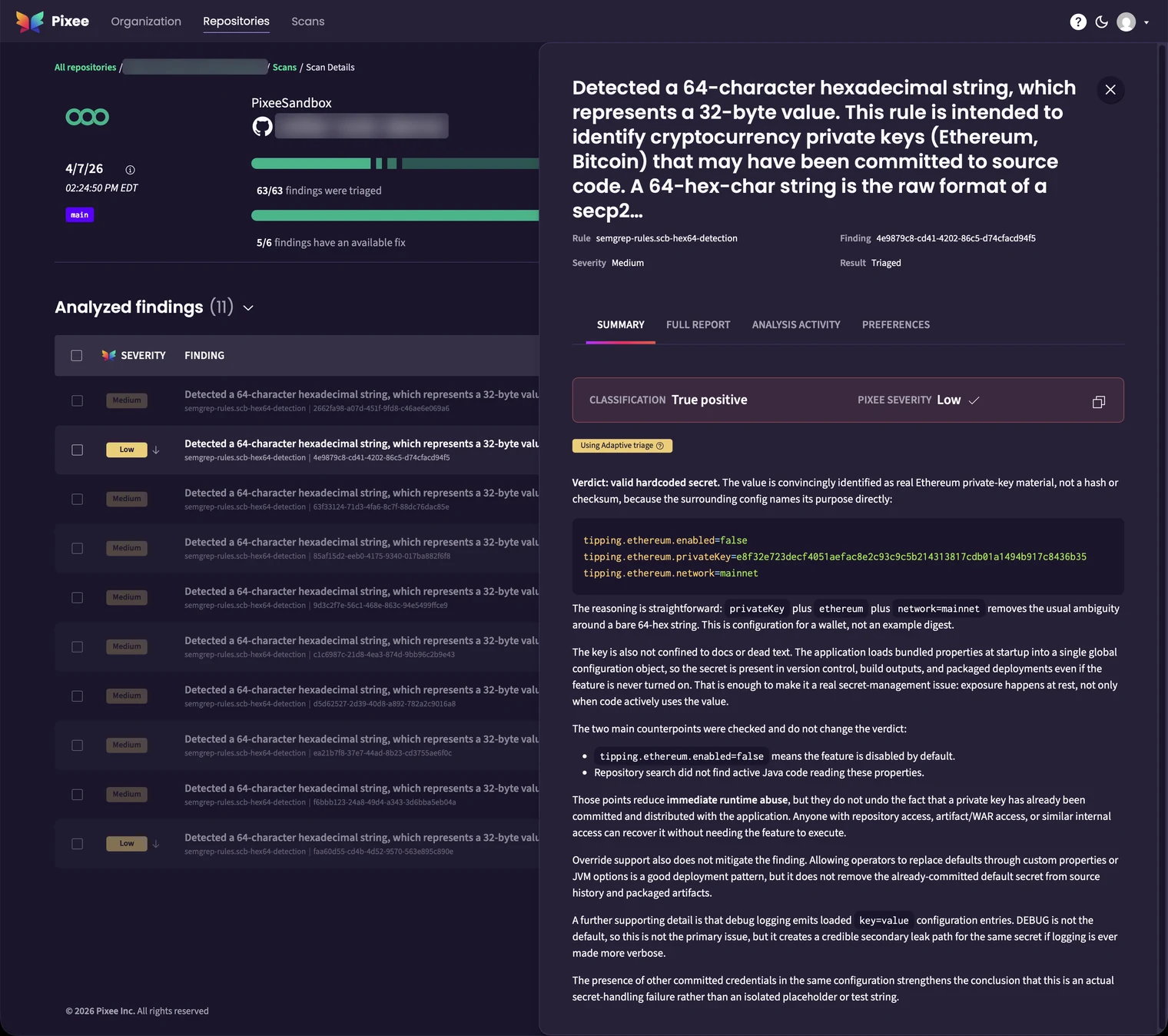
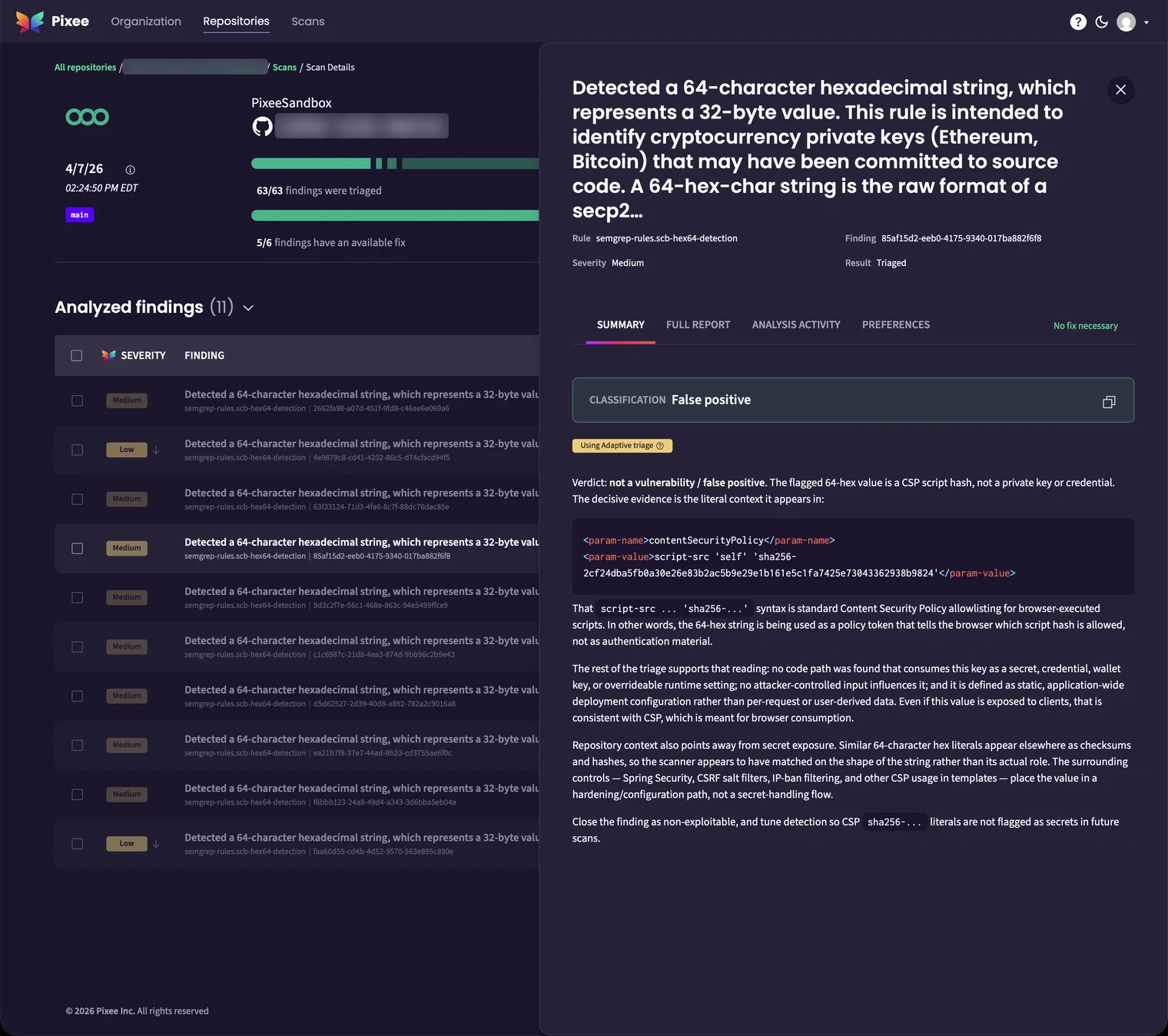
The same 64-hex value, triaged two ways.
Both findings below match the bank's noisiest rule, the 64-character hex pattern. Pixee reads the code around each and reaches opposite verdicts.
privateKey name beside network=mainnet, the "Crypto tipping" comment, and how the app loads its properties at startup.web.xmlcontentSecurityPolicy parameter name and the sha256- prefix.Pixee adds one step after the scan you already run. It reads each finding and passes a verdict to your build. False alarms stop blocking developers, and real secrets still stop the build. Your Gitleaks or SonarQube scan doesn't change.
For the bank's pilot, we also designed a step where Pixee prompts the developer's coding agent to open the Gitleaks suppression PR, with its evidence attached. Ask on a demo what's turnkey for your stack.
Each finding comes back with the files Pixee read, the controls it found and the counterpoints it checked. Your team gets a rationale it can defend in a review, not a verdict to take on faith.
Pixee triages secrets findings and hands your team the evidence. It doesn't rotate credentials, scrub git history or manage a vault. Fixing a leaked secret means rotating it and updating everywhere it's used, and that belongs with the people who own the system. Pixee gets them to the findings that matter, fast.
Secrets isn't a separate product. It's the same triage engine that already clears noise from your SAST and SCA findings, with the same code-context analysis and evidence. Every finding lands in one place.
In a self-hosted deployment, your code never leaves your infrastructure and is processed for analysis, not stored permanently. Air-gapped runs use a self-hosted LLM inside your perimeter, with no calls to a third-party model.
To test code-context triage, we ran the bank's own three detection rules against Apache Roller, a large open-source Java application seeded with real and fake secrets. We used a public reference codebase because we can't test on a customer's proprietary code. Pixee had never seen the rules. With zero configuration, it classified every finding correctly.
It found each one by reading the code that used it.
It cleared each one by reading the code that showed it wasn't a secret.
Pixee post-processes your existing secrets scanner's output, for example Gitleaks and custom SonarQube rules, by reading its SARIF report. Because Pixee derives a finding's meaning from the rule metadata and the surrounding code, it can triage rules it has never seen before, so it isn't limited to a fixed list. Your current scan and report stay untouched; Pixee adds the triage step.
It adds one step between your scan and the build gate: the time Pixee takes to triage that batch of findings. It runs as post-processing on your scanner's existing report, so it doesn't change the scan itself.
Your gate treats an inconclusive finding as not cleared, so the build fails and a human reviews it, the same as a true positive. Nothing passes on a finding Pixee couldn't confirm was safe.
Because the gate you wire only passes on a confirmed false positive, an error or timeout isn't a clearance. The build fails rather than shipping an unchecked finding.
No. Pixee triages. It tells you which findings are real and why. Rotating and replacing the credential stays with your team.
You choose. Pixee runs as cloud (SaaS), self-hosted in your own VPC, or fully air-gapped. In a self-hosted deployment your code never leaves your infrastructure. It's processed for analysis, not stored permanently. Air-gapped runs use a self-hosted LLM inside your perimeter.
Your scanner matches a pattern. Pixee reads the code around each match to tell a real secret from a look-alike, and shows its work.
Most secrets tools detect. They find more matches, or check whether a leaked key is still live. Pixee is a triage layer on top of the scanner you already run: it reads the code around each finding to decide which ones are real, with evidence.
Bring your last Gitleaks or SonarQube report. No rule tuning. See which of your findings are real, with the evidence for each.

The briefing security leaders actually read. CVEs, tooling shifts, and remediation trends — distilled into 5 minutes every week.
Join security leaders who start their week with the briefing. Free, 5 minutes, no fluff.
First briefing drops this week. Check your inbox.
Weekly only. No spam. Unsubscribe anytime.