
Clear the backlog.
Prevent the next one.

Pixee finds and fixes the attack paths in your backlog, works inside your coding agents, and catches the next risk at design time.
Get a DEMO
Pixee platform video
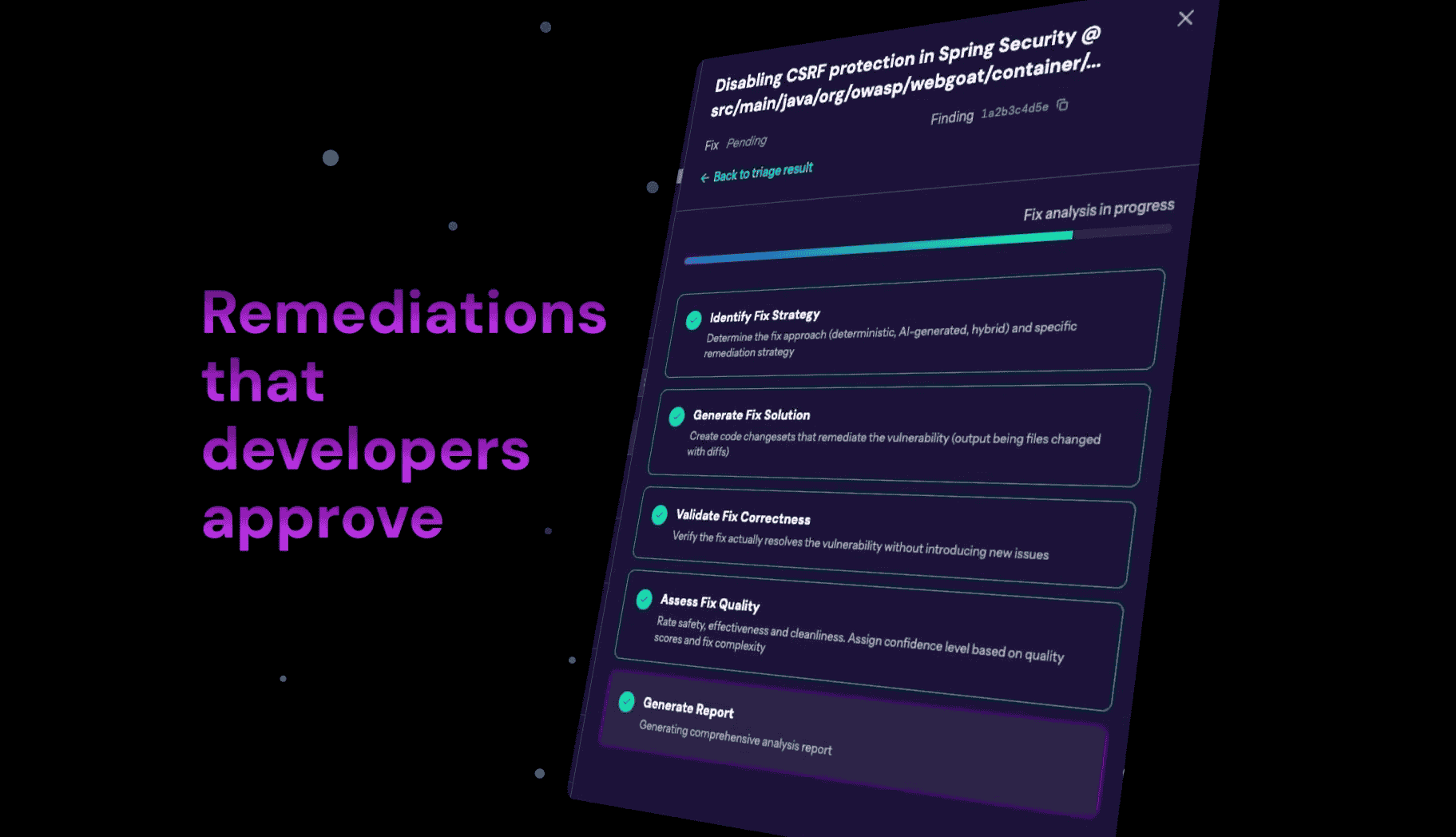
Each pull request carries the triage verdict and the analysis behind the fix, so your reviewers can check both before they merge.

One platform, design through merge

Pixee turns your design docs into a threat model, triages your scanner findings against your code, and opens a fix for the ones that can be exploited.

Markitecture Diagram

Design-stage security

A living threat model for every app

Foresight works from the spec, before any code exists, and turns it into a threat model that stays current as the code changes. Know any app's real exposure without a week of reading its code.

System Overview Exposure Attack Surface
Live · regenerates on commit

System overview · payments service

Client → API Gateway → Auth Service → Payments DB
! Unauthenticated path to PII.API Gateway can reach Payments DB, skipping the Auth Service.

Extracted security guarantees

✓Every payment route requires an authenticated sessionholds · verified in code
✓PII encrypted at restholds · verified in code
!Admin export assumes gateway authdrift · code diverged from the design
Generated by Pixee — regenerated as the code changes.

How Foresight keeps it living

Design Review

Reads the design before any code exists and flags the decisions that create risk — while they're still cheap to change.

Guarantee Extraction

Turns the security guarantees the design commits to into checkable requirements — so the model knows what the app must enforce.

Drift Detection

Watches for code diverging from those guarantees and flags the gap — the model stays true instead of going stale.

Exploit Chains

Find the attack paths hiding in your backlog

Severity scores send your team after the wrong findings. Exploit Chains shows which ones combine into an attack that works in your code, so you fix those first.

Threat ModelExploit Chains
MediumPath traversal✓ checked in code
MediumJWT signing key on disk✓ checked in code
OutcomeAccount takeover via a forged admin token✓ each step feasible

How a chain is built

Read the path, not a score

Every chain comes with an attack-flow diagram and a written narrative of each step.

Every step checked in code

Starting from your threat model, Pixee reads the code at each hop to confirm the step is feasible, not just plausible.

Crosses SAST and SCA

A vulnerable library plus an unsafe call in your own code can add up to remote code execution. Exploit Chains reads them as one path.

Capabilities & Coverage
SAST, SCA, DAST and secrets

Bring every finding into one queue. Pixee shows you which ones can actually be exploited, and fixes those.

Intelligent Triage Engine
Most findings do not need remediation. Pixee proves which ones do. Reachability analysis traces code execution paths to separate exploitable vulnerabilities from theoretical ones.
95%+
Reduction in False Positives
WHY PIXEE
The Pixee Context Graph
Pixee maps your codebase patterns and architectural constraints into one graph. It holds your team's conventions, policies and preferences and applies them to every fix.
Automated Fix Generation
Fixes arrive as merge-ready pull requests, each checked before it opens and reviewed like any other change.
76%
Merge Rate
Enterprise Scale
Your own dedicated instance, hosted by Pixee or by you. SOC 2 Type II and ISO 27001 compliant.
Air-Gap Ready

Works with your stack

Pixee connects with the tools you already use. From code repos to scanners and CI/CD, we orchestrate your entire remediation workflow.

Black Duck
SAST, SCA
Checkmarx
SAST, SCA
Datadog
SAST, SCA
GitHub Advanced Security
SAST, SCA, SCM
GitLab
SAST, SCA, SCM
JFrog Xray
SCA
Semgrep
SAST
Snyk
SAST, SCA
SonarQube
SAST
Sonatype
SCA
Veracode
SAST, SCA

Pixee CLI and agent plugin

Put a security expert inside every coding agent

Your agents run their code through Pixee's security harness, which triages findings and fixes the real ones, so you ship less vulnerable code that follows your security standards.

agent session
# Pixee already triaged this finding from your SAST scanner
# PR check failed: SQL injection flagged in the orders service
agent › pixee finding list --scan 7f3a --json
{
  "suggested_status": "true_positive",
  "reasoning": "request parameter reaches a raw SQL query",
  "fix": { "type": "completed-fix", "confidence": "high" }
}
agent › applying Pixee's patch, re-running the test suite
✓ tests passed · PR updated, waiting for review

What changes, and what doesn't

A verdict, not a guess

True positive, false positive or inconclusive, with the reasoning attached.

Your agent does the last mile

It applies Pixee's patch, reruns your checks and updates the pull request. A person still reviews and merges.

Security sees every answer

Whichever agent asks, the verdict and the fix show up in Pixee, next to everything else your team tracks.

For Security Teams

A verdict for every finding, and a fix for the real ones.

For Developers

Review a fix instead of researching a ticket.

For CISOs

A 94% end-to-end resolution rate, with an audit trail for every finding.

From Systems of Detection
To Systems of Decision

Your Existing Stack

The "What Exists" Layer
SAST
[SQL Injection in auth.ts] [XSS in profile.tsx] [Hardcoded Secret] [Insecure Randomness] [SQL Injection in auth.ts] [XSS in profile.tsx] [Hardcoded Secret] [Insecure Randomness] [SQL Injection in auth.ts] [XSS in profile.tsx] [Hardcoded Secret] [Insecure Randomness]
SCA
[Log4j Critical CVE-2021-44228] [Lodash Prototype Pollution] [Outdated React Version] [Express ReDoS] [Log4j Critical CVE-2021-44228] [Lodash Prototype Pollution] [Outdated React Version] [Express ReDoS] [Log4j Critical CVE-2021-44228] [Lodash Prototype Pollution] [Outdated React Version] [Express ReDoS]
ASPM
[Publicly Accessible S3 Bucket] [Shadow API Endpoint Detected] [PII Data Exposure] [Unencrypted Traffic] [Publicly Accessible S3 Bucket] [Shadow API Endpoint Detected] [PII Data Exposure] [Unencrypted Traffic] [Publicly Accessible S3 Bucket] [Shadow API Endpoint Detected] [PII Data Exposure] [Unencrypted Traffic]
JIRA
[SEC-1029: Fix Critical Vuln] [SEC-1030: Dependency Review] [SEC-1031: Patch Management] [SEC-1032: Audit] [SEC-1029: Fix Critical Vuln] [SEC-1030: Dependency Review] [SEC-1031: Patch Management] [SEC-1032: Audit] [SEC-1029: Fix Critical Vuln] [SEC-1030: Dependency Review] [SEC-1031: Patch Management] [SEC-1032: Audit]
Pixee's Context Graph
The "Why It Happened" Layer

Every security decision leaves a trace.

Not just a snapshot. A history.

The 4 Layers of Context

How Pixee builds your organization's institutional memory

Process Context

Security policies, architectural patterns, governance rules.

The "what should happen"

Raw Context

Code, scanner findings, dependencies, configurations.

The "what exists"

Kinetic Context

Exploitability analysis, security controls in your code, and correlation across scanners.

The "what is exploitable"

Human Feedback Context

Merge/reject patterns, organizational preferences, precedents.

The "what you trust"
"We used to audit the code. Now the thing writing the code also writes the tests that check it. So what has to be auditable is the reasoning: what the system knew, what it decided, and why. That's the layer we built."
Surag Patel, Pixee

Choose your environment

Whether you need speed or sovereignty, Pixee runs where your code lives.

Pixee-hosted
For Speed & Simplicity
The fastest way to start. Pixee runs your instance for you.
Instant onboarding via GitHub App
SOC2 Type II Compliant infrastructure
Automatic engine updates
Schedule Your Demo
Enterprise Preferred
Self-Hosted
For Control & Sovereignty
Complete data control. Run Pixee inside your VPC or air-gapped environment. Your code never leaves your perimeter.
Zero data egress required
Custom model finetuning on your code
Meet stringent enterprise security requirements
Schedule Your Demo

Your backlog's been growing for years.

Let's fix that this month

Schedule your demo