On August 27, OpenAI and more than 100 companies published an open letter warning that AI-enabled cyberattacks are about to get far more widespread, and that the defense starts with the oldest items on the list: unpatched software, weak authentication, and sloppy identity management. Then look at this week's tape. A CVSS 9.1 unauthenticated Keycloak account takeover, a GitLab flaw exploited within days of disclosure, and Akamai's finding that your most capable engineers are wiring unreviewed AI into production. The letter is the frame; the stories below are the evidence, arriving on schedule.
On Thursday, OpenAI published an open letter on collective cyber defense co-signed by more than 100 technology, cloud, finance, and critical-infrastructure companies, including Anthropic, AWS, Microsoft, Google, Cisco, CrowdStrike, and Cloudflare. The warning at its center is blunt: "In the coming months, AI-enabled cyber attacks will become far more widespread and sophisticated as models around the world become increasingly capable." The letter names hospitals, water utilities, power infrastructure, and the plumbing of the internet as what's at stake, and coverage points to a mid-August NSA/CISA/FBI advisory that attackers are already using AI to develop exploit scripts against industrial control systems in U.S. energy, water, and manufacturing sectors.
What the letter asks for is not a new alliance or a fund. Its three principles are to recognize that status quo security won't be enough, to empower more defenders with cyber-capable AI, and to mobilize a collective response. The concrete work sits underneath: fix unpatched software, weak authentication, and poor identity and privilege management now, especially in critical infrastructure, and keep agentic identities traceable and accountable as AI takes on more operational work. The signatories want leadership to own that list, not a back-office queue.
Read against the rest of this edition, none of that stays abstract. "Weak authentication" is the Keycloak CVSS 9.1 unauthenticated account takeover and the actively exploited GitLab flaw covered below. "Keep agentic identities accountable" is the Akamai super-adopter problem, AI wired into production paths by the people nobody is reviewing. The signatories just described this week's news before it happened.
Run the letter's list against your own estate this week: internet-facing services still carrying last quarter's patches, auth flows without hardened reset paths, AI integrations holding credentials no named human owns. And take "empower defenders with AI" at its practical meaning, which is automating that unpatched-software and weak-auth backlog, because the letter's whole premise is that attackers are automating theirs first.
The letter's warning about unaccountable AI already has a case study: while most security programs spend their AI energy policing who pastes company text into ChatGPT, Akamai's research points somewhere else. The top 5% of enterprise power users are hardwiring unvetted AI tools into production workflows, customer-facing systems, and data pipelines. That is not casual usage. It is unreviewed integration surface, built by the most capable people on the team, sitting in the paths that matter most.
The controls meant to catch this are shakier than the marketing suggests. Researchers this week showed a Cryptographic Context Injection technique that slips past safety guardrails in Grok and Gemini by hiding instructions until they decrypt inside the model. The tl;dr sec shadow-AI briefing puts the through-line plainly, warning that a shadow app integration today is a supply-chain attack vector tomorrow. A helper browser extension or an AI connector wired into a build is a dependency nobody added to the SBOM.
Your AI policy is probably pointed at the wrong people. Find the handful who have wired a model into a production path, and treat every integration you cannot name a reviewer for as a dependency you never vetted.
Red Hat shipped an emergency patch for a Keycloak flaw rated CVSS 9.1 that lets an unauthenticated attacker take over any account by forcing a password reset. In the same window, GitLab CVE-2026-19478 came under active exploitation within days of disclosure, and CISA added actively exploited Zimbra and TrueConf Server flaws to its Known Exploited Vulnerabilities catalog, the latter already used by the Head Mare group to deploy PhantomCore malware.
The common thread is timing. The gap between a public advisory and a working exploit keeps shrinking, and it now runs shorter than most enterprise change windows. When the identity platform itself is the vulnerable component, there is no upstream boundary to hide behind while you schedule the fix. The patch and the exploit are now racing on the same clock, and the exploit had a head start this week.
Pull your last five emergency patches and compare two numbers: hours from disclosure to exploit, against hours from advisory to your deployed fix. When the first is smaller, your identity systems are the ones with no perimeter to cover the gap while you wait on a change window.
Anthropic expanded Claude Security's Mythos 5 codebase scanning to more enterprise customers and announced a $35M open-source security fund. It arrived alongside GitHub's own scorecard: its Secure Open Source Fund reported $500,000 across 50 projects in one session, and $1.88M across 188 projects to date. Two of the companies whose models generate the most new code are now directly funding the maintainers that code leans on.
The timing is not charity theater. This same period, attackers with North Korean infrastructure overlap compromised the arrayref Rust crate and slipped in a dependency that ran a payload at build time, before any review. GitHub's work with 50 projects named the limit of the money plainly, finding that AI helps maintainers triage faster while they still supply the judgment and accountability for what ships. The funding buys tooling and time; it does not buy the human review that catches a poisoned crate.
A funded maintainer is a slightly safer maintainer, not a safe dependency. The action the arrayref attack calls for is knowing which of your dependencies can run code at build time, because that is where a poisoned release cashes in before anyone reads it.
CVE-2026-72529 · TrueConf Server (critical · actively exploited · KEV)
First half of an unauthenticated exploit chain; Head Mare used it to run a malicious script over the default-open port 4307. Details
CVE-2026-72530 · TrueConf Server (critical · actively exploited · KEV)
The sandbox-escape half of the chain, giving arbitrary code execution on the server, then a trojanized client planting the PhantomCore backdoor. Details
Zimbra Collaboration · Zimbra (critical · actively exploited · KEV)
Unauthenticated command execution under active attack; CISA ordered urgent federal patching. Details
CVE-2026-18963 · Keycloak (CVSS 9.1 · patch available)
Unauthenticated account takeover via forced password reset on the widely deployed IAM server; Red Hat shipped an emergency fix. Details
isolated-vm · Node.js sandbox library (critical · patch available)
Type-confusion bug enabling a V8 sandbox escape and control-flow hijack of the host process. Details
CVE-2026-19478 · GitLab CE/EE (high · actively exploited)
Unauthenticated modification or deletion of public projects, exploited within days of disclosure. Details
BTR.sys technique · Microsoft Defender (no CVE · PoC disclosed)
Check Point showed Defender's own signed boot-time driver performing kernel-level file and registry operations to remove security software, with no external driver imported. Details
Modernizing the NVD in the Age of AI · jericho.blog Why it's worth your time: a candid Q&A on why the National Vulnerability Database has degraded over two years and what AI can and cannot fix about it. Read it if your prioritization still leans on NVD data.
Exploits and Vulnerabilities in Q2 2026 · Kaspersky Securelist Why it's worth your time: the quarter's exploit and C2 statistics, and the first edition to aggregate vulnerability data on open-source AI agents and frameworks, the exact estate this week says you now have to inventory.
Defeating AI-Assisted Reverse Engineering (or at Least Trying To) · Quarkslab Why it's worth your time: Quarkslab hands sandboxed agents progressively hardened binaries and reports where the agents broke and where they stalled, a grounded counterweight to both AI hype and AI panic.
What's in a Tag Name? JavaScript, Apparently · PortSwigger Research Why it's worth your time: PortSwigger shows how unusual characters in HTML tag names become executable payloads that slip past filters, a concrete reminder that allowlist-by-simple-rule leaks.
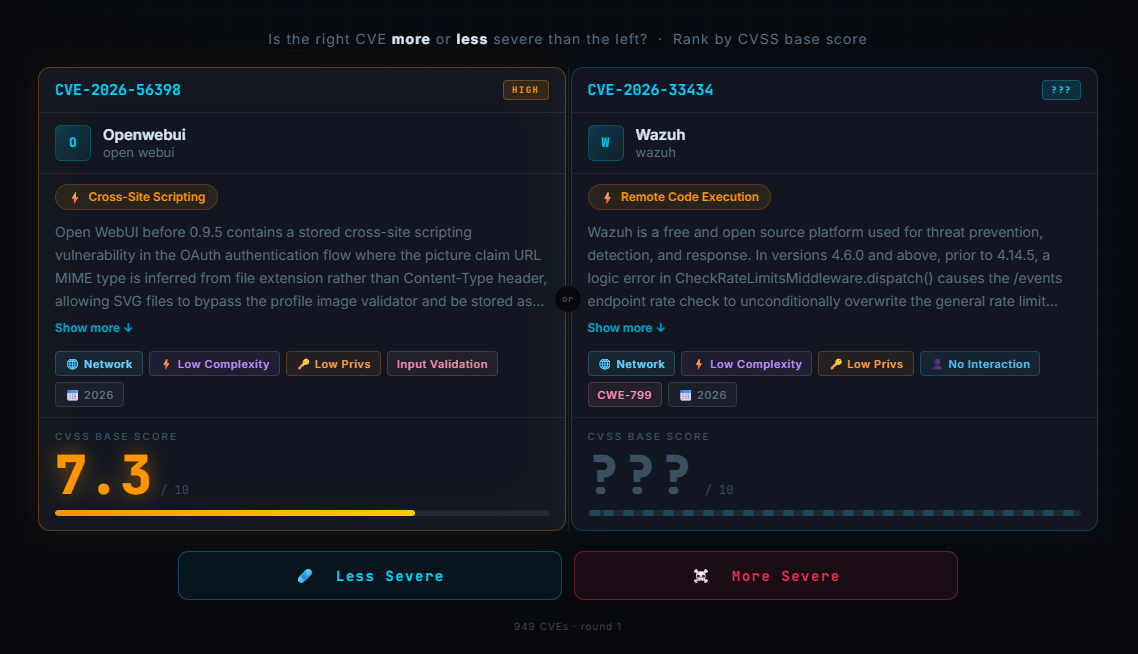
Patch or Panic · built by our team Why it's worth your time: a two-CVE guessing game that puts two real CVEs side by side and asks which scores higher on CVSS. A fun warm-up before your next triage session.
Patch or Panic — how good is your CVSS gut? Two CVEs, one call.

The briefing security leaders actually read. CVEs, tooling shifts, and remediation trends — distilled into 5 minutes every week.
Join security leaders who start their week with the briefing. Free, 5 minutes, no fluff.
First briefing drops this week. Check your inbox.
Weekly only. No spam. Unsubscribe anytime.