78% of Security Alerts Go Uninvestigated: The Silent Risk Accumulation

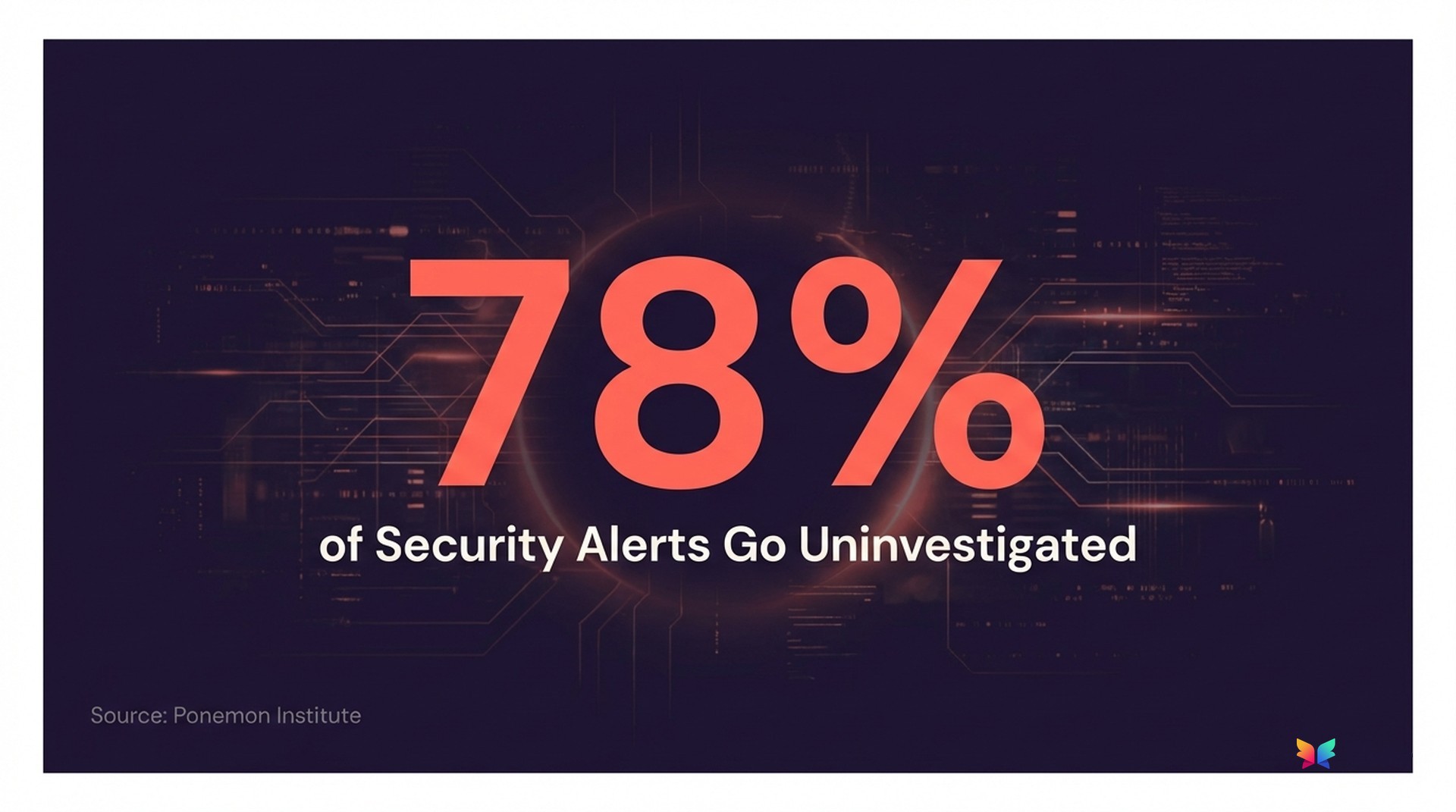
Every morning, you wake up to the same overwhelming reality: thousands of new alerts flooding your dashboard. Ponemon Institute research shows 78% of these alerts will never get investigated.
Your team triaged 200 alerts last week. This week it's 300. Next week, 450. The backlog grows faster than you can hire.
This isn't just about missed alerts. While your team burns out chasing false positives, real vulnerabilities slip through, creating a dangerous gap between what you think your security posture looks like and what it actually is.
The Scale of Security Alert Overload
The numbers are staggering. The average enterprise security team processes over 10,000 alerts daily, according to SANS Institute research.
Gartner research shows alert volume has grown 300% over the past five years. Security team sizes stayed relatively flat. Each security analyst now handles roughly 40% more alerts than they did two years ago.
Tool sprawl compounds the problem. ESG research indicates that enterprise security teams manage an average of 76 different security tools, each generating its own stream of alerts with different formats, priorities, and contexts. This complexity mirrors what we've seen with developer toolchain attack vectors.
Why Alerts Pile Up Uninvestigated
False Positive Fatigue
The overwhelming rate of false positives drives most of the problem. Forrester's "The State of Security Operations 2023" report found that 71-88% of security alerts are false positives. When you know most alerts won't lead to actionable findings, investigation becomes a game of probability rather than priority.
Resource Constraints
ISC2 workforce studies consistently show a global shortage of 3.5 million cybersecurity professionals. Your team is stretched impossibly thin, forcing difficult triage decisions about which alerts deserve attention.
Lack of Context
Most security tools generate alerts without sufficient context about business impact, exploitability, or reachability. A "Critical" CVE alert lacks value without understanding whether it's actually exploitable in your specific environment. This is why validating AI-powered vulnerability triage has become essential for modern security teams.
The Hidden Costs of Alert Overload
Risk Accumulation
Every uninvestigated alert represents potential risk accumulation. Verizon's Data Breach Investigations Report shows that 76% of breaches involve vulnerabilities that were known but not prioritized for remediation. As we explored in our analysis of why time-to-exploit has collapsed, attackers now weaponize vulnerabilities faster than most teams can respond.
Real threats hide in the noise.
Compliance Failures
Regulatory frameworks increasingly require you to demonstrate that security alerts are properly investigated and resolved. PwC's compliance research found that 34% of organizations failed recent audits specifically due to inadequate alert investigation documentation.
Team Burnout and Turnover
Cybersecurity Insiders' 2023 workforce stress report reveals that 67% of security professionals report high stress levels directly related to alert overload. The constant pressure to investigate impossible volumes leads to burnout, with average security team turnover rates reaching 18% annually.
Business Impact
The business costs extend beyond security teams. IBM's Cost of a Data Breach report shows that organizations with high alert fatigue experience 23% longer breach detection times, directly correlating to higher breach costs.
The Psychology Behind Alert Fatigue
Alert overload triggers psychological effects beyond simple workload issues. Research published in the Journal of Cybersecurity identifies several cognitive biases that emerge:
Decision Paralysis: When faced with thousands of alerts, teams freeze.
Confirmation Bias: Teams begin investigating only alerts that match patterns they've seen before, ignoring potentially novel attack vectors.
Cry Wolf Effect: After numerous false positives, teams become desensitized to alerts entirely, treating even legitimate threats with skepticism.
Real-World Impact: Industry Examples
Healthcare Under Siege
A major healthcare system recently shared data showing they receive over 15,000 security alerts daily across their network of hospitals. With a security team of just eight analysts, mathematical impossibility means 89% of alerts never get human eyes.
"We're essentially flying blind," their CISO admits. "We know there are real threats in that pile of alerts, but finding them is like searching for a needle in a haystack while someone keeps adding more hay."
Financial Services Compliance Crisis
A regional bank faced regulatory action after auditors discovered that 82% of their security alerts over a six-month period had no investigation records. The bank's compliance team couldn't demonstrate due diligence in threat detection, resulting in a $2.3 million penalty.
Technology Company's Wake-Up Call
A fast-growing SaaS company discovered they had missed a critical data exfiltration attempt that was flagged by their SIEM but buried among 8,000 other alerts that week. The incident, which exposed customer data for three months before discovery, cost them $4.7 million in breach response and customer compensation.
Breaking the Cycle: Strategic Solutions
Automation-First Triage
The solution isn't hiring more analysts. It's changing how alerts get processed. Gartner's Market Guide for Security Orchestration, Automation and Response Solutions shows organizations increasingly turn to automated triage for initial assessment and categorization.
Effective automation focuses on:
• Reachability analysis: Determining if vulnerabilities are actually exploitable in your environment
• Business context: Prioritizing alerts based on asset criticality and business impact
• Threat intelligence correlation: Matching alerts against current threat landscapes
Unified Visibility Platforms
Rather than managing 76 different security tools, leading organizations consolidate to unified platforms for centralized visibility. Research from Forrester's security platform analysts indicates this approach can significantly reduce alert volume and improve investigation efficiency.
Risk-Based Prioritization
Modern security operations focus on risk scoring rather than alert volume. NIST's Cybersecurity Framework 2.0 emphasizes risk-based approaches that help teams focus on threats that actually matter to their organization.
Building a Sustainable Alert Management Strategy
Measure What Matters
Stop measuring security team performance by alert closure rates. Instead, focus on:
• Mean time to investigate legitimate threats
• False positive rates by tool and alert type
• Risk reduction achieved through investigations
• Team satisfaction and retention metrics
Invest in Context, Not Volume
The goal isn't to investigate every alert. It's to investigate the right alerts effectively. This requires tools that provide business context, exploitability analysis, and clear prioritization.
Train Teams for Triage
Security teams need training specifically focused on rapid triage techniques, not just incident response. SANS Institute's security operations curriculum now includes modules specifically on alert management and triage automation.
Key Takeaways for Security Leaders
Three truths:
Accept Mathematical Reality: No security team can investigate 10,000+ daily alerts. Success means investigating the right alerts, not all alerts.
Prioritize Automation Investment: Automated triage isn't replacing human expertise. It's preserving it for high-value security work where human judgment is irreplaceable. Security leaders increasingly see this as essential to their AI security playbook.
Measure Outcomes, Not Activity: Alert investigation rates matter less than risk reduction and threat detection accuracy.
Build for Sustainability: Security operations must be designed for long-term team health and retention, not short-term alert processing speed.
The organizations succeeding in modern threat landscapes aren't processing the most alerts. They're processing the most relevant alerts effectively.
The Path Forward
Security leaders must acknowledge that current approaches are mathematically unsustainable.
Rather than attempting to scale human resources to match alert volume, successful organizations implement intelligent automation for initial triage while preserving human expertise for complex analysis and strategic decision-making.
The focus must shift from alert quantity to alert quality, ensuring security teams spend their valuable time on threats that pose genuine risk to their specific environments.
The silent risk accumulation stops when you stop accepting alert overload as inevitable. Build security operations that scale with modern threat landscapes, not against them. Organizations that embrace this shift, combining automation, risk-based prioritization, and sustainable team practices, will be better positioned to detect and respond to the threats that truly matter.
For more insights on building sustainable security operations, explore what security leaders learned in 2025 and what they're watching in 2026.
Explore the Full Guide
This post is part of our triage automation resource center resource center. Explore the full guide for frameworks, benchmarks, and implementation playbooks.