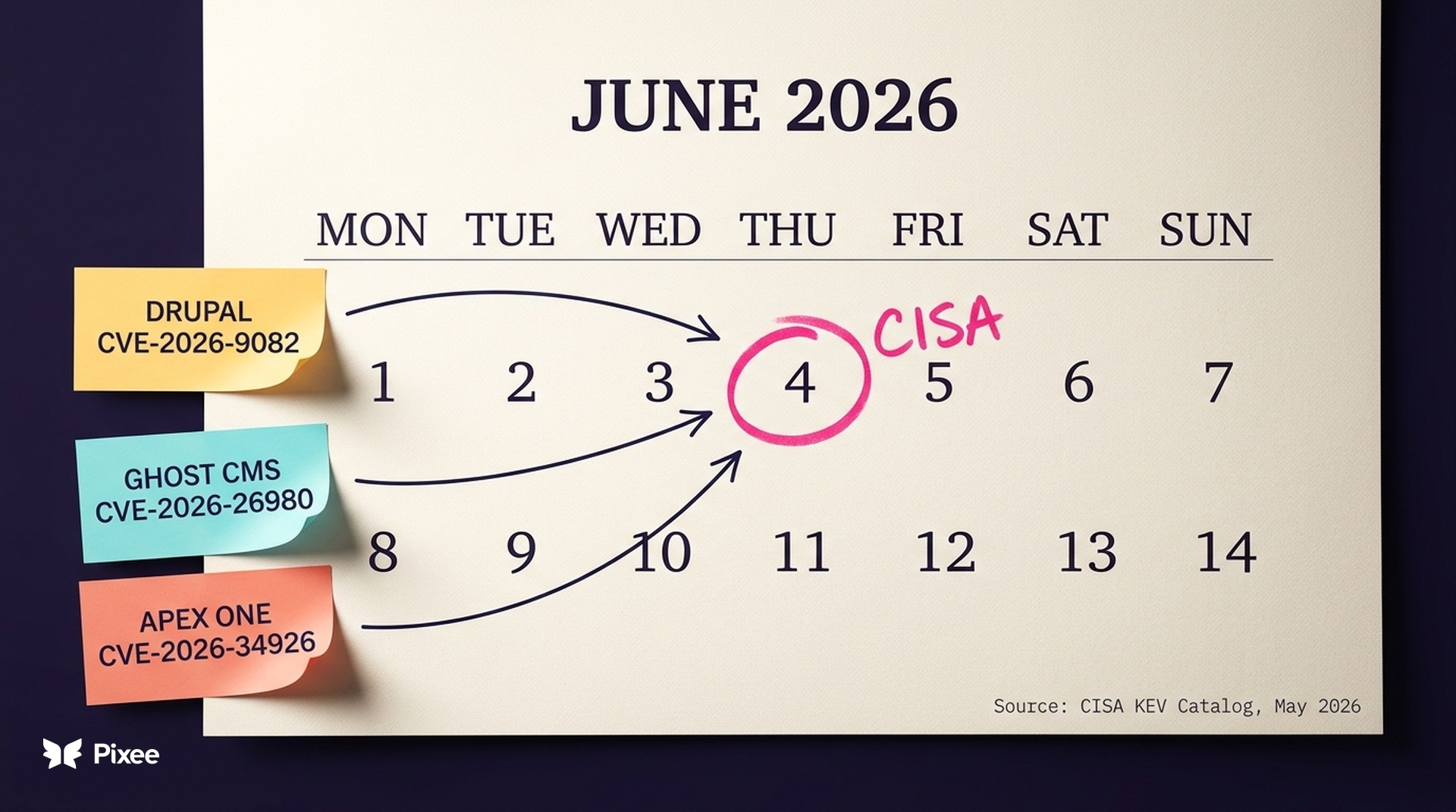
Three actively-exploited code-level CVEs landed at once, and CISA put a federal June 4 patch deadline on the worst of them (Trend Micro Apex One on-prem). Researchers separately showed soft-target zero-day discovery is now a $20 problem, and the Laravel Lang supply-chain attack used a tactic that quietly defeats version pinning. Worth a read even if you do not run PHP.
Action this week: If you run Trend Micro Apex One on-prem, patch by June 4 (CISA federal mandate). If you run Drupal core on PostgreSQL or Ghost CMS 3.24–6.19, patch immediately — both are under active automated exploitation. If your critical-patch SLA is 30 days, this is the week it shows up in your next quarterly review.
Drupal SA-CORE-2026-004 (CVE-2026-9082) is an unauthenticated SQL injection in Drupal core's database abstraction API affecting PostgreSQL-backed sites; Imperva observed over 15,000 exploitation attempts across nearly 6,000 sites in 65 countries within days of disclosure. A separate SQL injection in Ghost CMS (CVE-2026-26980, CVSS 9.4), affecting versions 3.24.0 through 6.19.0, was used to compromise 700+ sites in a ClickFix campaign that stole Admin API keys to inject malicious JavaScript loaders.
The third one is on a government clock. Trend Micro Apex One (on-prem) CVE-2026-34926 is a directory-traversal flaw in the management console; CISA added it to KEV with a federal remediation deadline of June 4.
If your critical-patch SLA is still 30 days, that is the gap to flag for your next quarterly review.
Google DeepMind introduced CodeMender in October 2025 as a standalone agent that found and patched vulnerabilities, claiming 72 upstreamed fixes across codebases as large as 4.5 million lines. At I/O 2026, Google announced CodeMender is now a component of its broader Agent Platform, bundled with identity, gateway, and observability rather than offered as a standalone product. Enterprise Management Associates' Chris Steffen read the move as a strategy pivot rather than a product update.
GitLab made a parallel move the same week with native secrets management and AI merge-request workflows in 19.0, suggesting platform-bundled AppSec is the emerging vendor pattern, not the exception.
If you were evaluating CodeMender as a standalone remediation agent, the procurement question changed this week: it is now a platform component, not a point tool.
Researchers from TrendAI and CHT Security presented a pipeline at Ekoparty Miami that finds WordPress plugin zero-days for roughly $20 each, built in three days, pairing AI-driven static analysis with automated Docker provisioning and Chrome DevTools MCP verification. That $20 figure applies to a soft target (single-file PHP plugins with a known attack surface), not arbitrary enterprise code.
The throughput, not the technique, is the part to watch — the WordPress plugin marketplace is north of 60,000 extensions, and that is where discovery economics matter most.
The Laravel Lang compromise on Packagist did not drop a malicious new package. Attackers rewrote GitHub tags so 200+ historical releases were republished with a credential stealer targeting cloud keys, SSH credentials, and browser data through Composer installs; Aikido confirmed the payload reach across more than 200 versions. Pinning a version or trusting an SBOM assumes the bytes behind a version number do not change. Tag rewriting changes them while the number stays put. The same actor cluster (TeamPCP / Mini Shai-Hulud) also hit TanStack on npm, and Grafana confirmed codebase theft through that vector.
If your supply-chain control is version pinning plus an SBOM, this is the attack it does not catch.
This week: 50+ items tracked | 3 actively exploited | 1 zero-day | 4 supply-chain incidents
• CVE-2026-9082 — Drupal core (PostgreSQL sites) Severity: Critical | Impact: Unauthenticated SQL injection | Status: Actively exploited (15,000+ attempts, ~6,000 sites)
• CVE-2026-34926 — Trend Micro Apex One (on-premise) Severity: High (CVSS 6.7–7.8) | Impact: Directory traversal in the console | Status: Zero-day, in CISA KEV, federal fix-by June 4
• CVE-2026-26980 — Ghost CMS (3.24.0–6.19.0) Severity: Critical (CVSS 9.4) | Impact: Unauthenticated Content API SQLi, Admin API key theft | Status: Actively exploited (700+ sites, ClickFix)
• CVE-2026-27886 — Strapi (4.0.0–5.36.1) Severity: Critical | Impact: Boolean-oracle exfiltration of admin reset token, account takeover | Status: Disclosed (20,000+ exposed hosts)
• CVE-2026-0265 — Palo Alto PAN-OS (CAS-enabled) Severity: Critical | Impact: JWT forgery, authentication bypass as any trusted user | Status: Disclosed with detection tooling
• Underminr — Shared CDNs / trusted-domain routing Severity: High | Impact: Hides malicious connections behind trusted domains to bypass checks | Status: Disclosed (affects millions of sites)
• Chromium Service Worker flaw — Chromium (Chrome, Edge, Opera) Severity: High | Impact: Persistent JS execution across restarts; browser hijack for DDoS/crypto-mining | Status: Unpatched, details leaked
Six reads that earn the slot.
AI Tooling Watch
When the Scanner Starts Thinking: Mythos & GPT 5.5 Cyber in Security Testing — Why it's worth your time: Zscaler's defender-side read on frontier models that reason across attack paths rather than pattern-match. Useful if you are evaluating LLM-assisted security tooling.
Anthropic Patches a Claude Code RCE Flaw Triggered by a Crafted Deeplink — Why it's worth your time: If your developers use AI coding assistants, this is the attack-surface example to walk them through. Click a link, lose the box.
Thought-Provoking
We Hardened zizmor's GitHub Actions Static Analyzer — Why it's worth your time: Trail of Bits validated zizmor against 41,253 real workflows from 6,612 top repos to close YAML-anchor blind spots in GitHub Actions static analysis.
Navigating Lax Load Balancers: When an Intersection Gets You Inside — Why it's worth your time: A practical walk through how AWS ALB listener-rule chains become an authentication-bypass surface. The kind of misconfiguration no CVE will ever flag.
Current Events
UK Cybercrime Journal: Inside the Cl0p Attack on South Staffs Water — Why it's worth your time: Cl0p sat undetected in a UK water utility for nearly two years; the ICO fined them £963,900 and documented zero vulnerability scans over an 18-month window.
Deleted Google API Keys Keep Working for Up to 23 Minutes — Why it's worth your time: Aikido found Google API key revocation is not instant. A small, concrete fact that should change how you sequence incident response after a key leak.
AppSec Weekly is curated by the Pixee team from open-source security feeds and analyst reports. We cover what AppSec leaders, CISOs, and engineering executives need to track without reading 100 RSS feeds.
Previous AppSec Weekly editions: May 17-19 — A Windows Bug Microsoft Fixed in 2020 Is Live Again, May 11-12 — SLSA Cleared the Malware.

The briefing security leaders actually read. CVEs, tooling shifts, and remediation trends — distilled into 5 minutes every week.
Join security leaders who start their week with the briefing. Free, 5 minutes, no fluff.
First briefing drops this week. Check your inbox.
Weekly only. No spam. Unsubscribe anytime.