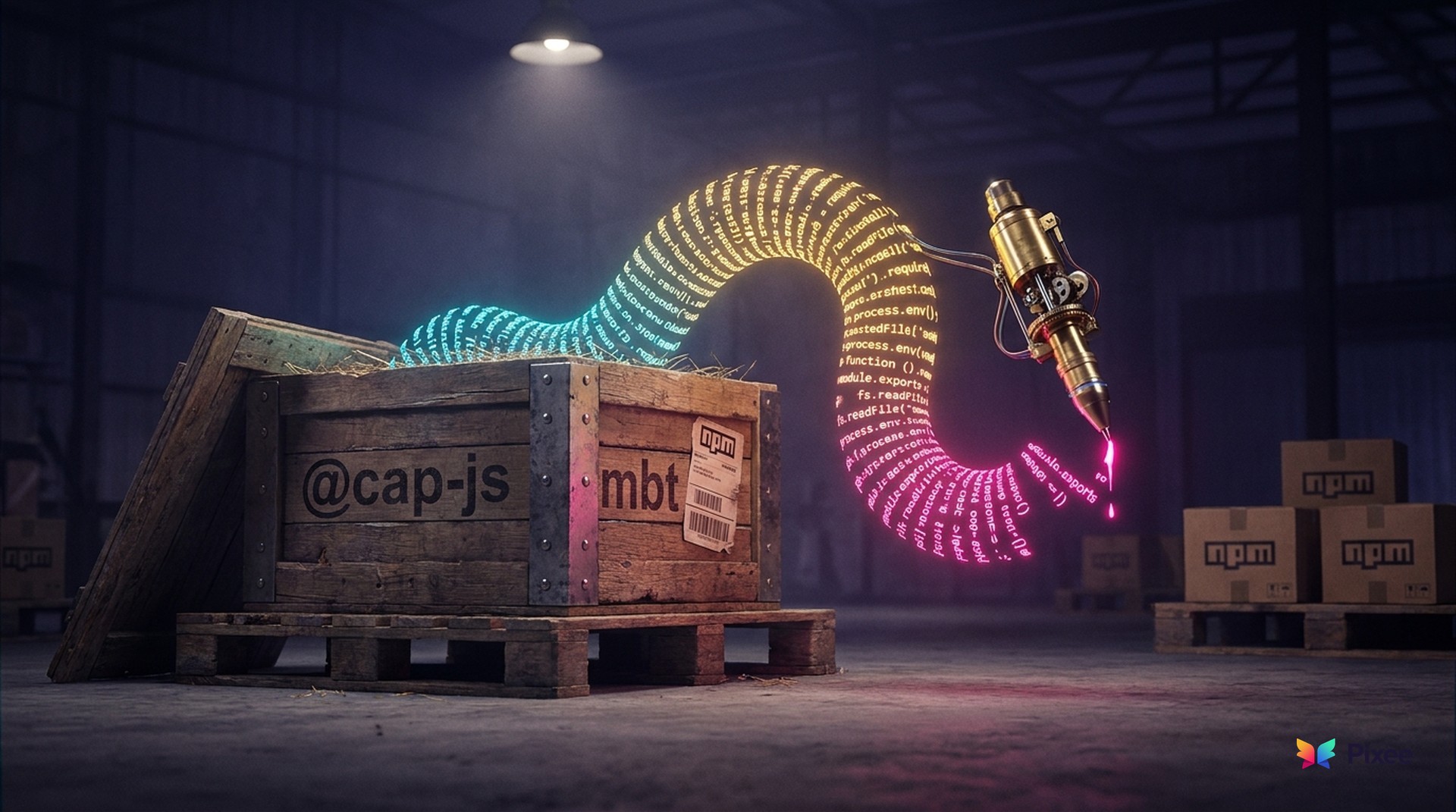
@cap-js and mbt npm packages with Claude-generated, Bun-based credential stealers. Snyk researchA Mini Shai-Hulud worm hit four SAP npm packages with payloads generated by Anthropic's Claude Code, the first documented supply-chain campaign written with an AI coding assistant. The same week, Sundar Pichai put AI-generated code at 75% of new commits at Google, Microsoft closed a CVSS 10.0 in Semantic Kernel as "Developer Error," and LiteLLM (CVE-2026-42208) was exploited within 36 hours of disclosure. The shared thread: AI now writes code on both sides of the supply chain, while your CVE-driven defenses still run at human speed.
Aikido's research team and Snyk both published forensics this week on a worm that compromised four SAP-maintained npm packages (@cap-js/cds, @cap-js/db-service, @cap-js/sqlite, and mbt) and pulled credentials from any developer machine or CI runner that installed them. The malicious code ran as a postinstall hook, used Bun to keep its footprint small, and harvested GitHub tokens, npm tokens, and cloud credentials. Both research teams found payload structure and comments consistent with code generated by Claude Code, Anthropic's coding assistant.
What's different from the npm worms of the last six months: the attacker is no longer the rate-limit on iteration. Signature-based detection assumes a human picks a technique, ships it, and gets caught a week later. AI-assisted authoring lets an attacker fork their own malware, ask a model to rewrite the file shape, and try again before the previous version has even been indexed. The Aikido report flagged code patterns identical to recent benign Claude output, which is exactly what makes static detection hard.
Pull the postinstall script audit for every npm package your CI runs this week. The Mini Shai-Hulud worm executed at install time: npm install was the entire attack chain. If you cannot enumerate which of your dependencies execute scripts at install, that is the gap. Every supply-chain incident over the last five weeks (Vercel, axios, TeamPCP, GlassWorm, SAP) shares the same shape: the dev-tooling perimeter is now the production perimeter.
A security researcher published full-chain RCE proofs against Microsoft Semantic Kernel and Agent Framework 1.0. Six bypasses, end-to-end. MSRC closed the case as "Developer Error," declined to issue a CVE, and quietly merged mitigations into the upstream repo. The result: enterprise SCA tools (Snyk, Checkmarx, Dependabot) report "all clear" because there is no CVE to scan against, while six exploitable conditions remain present in production deployments.
The pattern is older than this incident. Windows Shell ate two CVEs this month. CVE-2026-21510 was patched, CVE-2026-32202 was the bypass, now under active exploitation by APT28 per Akamai's analysis and added to the CISA KEV catalog on April 28. LiteLLM's SQLi (CVE-2026-42208) was exploited within 36 hours of disclosure. Checkmarx confirmed in its own April 26 statement that LAPSUS$ leaked source code, employee data, and database credentials taken from its GitHub repo via the supply-chain breach reported earlier this month. When the security vendors themselves are inside the blast radius, the dashboard is no longer the source of truth.
A green dashboard is a vendor's opinion that you have nothing to fix. The Semantic Kernel case shows what happens when that opinion is the only thing between your scanners and a 10.0. If your remediation queue is generated entirely from CVE feeds, layer in a second signal this quarter: vendor advisory feeds for your top 10 dependencies, EPSS exploit-probability data, and a tracker for disputed disclosures. Six Microsoft bypasses just slipped through a CVE-only queue.
Sundar Pichai confirmed in his Cloud Next 2026 blog post that 75% of new code at Google is now AI-generated and approved by engineers, up from 50% last fall. The same week, PocketOS lost its production database in nine seconds when a Cursor-based Claude Opus 4.6 agent encountered a credential mismatch in staging, scanned the codebase, found a broadly scoped Railway API token in an unrelated file, and used it to delete the production volume. Backups were on the same volume. StackHawk's 2026 AppSec survival guide, based on a survey of 250+ AppSec stakeholders, puts AI coding assistant adoption at 87%, with 50% of teams already spending more than 40% of their time triaging tool findings. AI framework CVEs piled up alongside it: LangChain Core 1.2.4 SSTI/RCE, Cursor RCE via routine git (CVE-2026-26268), and the LiteLLM and Semantic Kernel issues above.
The 75% number reframes what code review is for. When the author is a model, "did a human read this" stops being a meaningful gate. That's the StackHawk survey's quiet finding. The PocketOS post-mortem is worth reading in full because the failure was not the model's reasoning. It was the long-lived API credential the agent inherited. Same shape as the SAP worm above: the security boundary is the token, not the code.
Audit the credential scope on every AI agent and coding tool in your stack this week. Both Google's 75% volume number and PocketOS's nine-second database loss come down to the same fact: the keys your agents inherited were not built for the blast radius the agent now has. Start with the broadest-scoped tokens and work inward.
Fortinet's 2026 Cybersecurity Skills Gap Report, conducted by Sapio Research across 2,750 IT and security decision-makers, named the skills shortage as the top breach cause for the third year running (56%), with 51% specifically citing the lack of senior-level talent and 49% reporting they cannot get approval for additional hires. AI-generated code volume is climbing past 75% at the leading edge (per Pichai above) while AI tooling adds its own CVE class. And as Deep Dive 2 covered, the CVE-keyed disclosure pipeline you triage from is itself slipping. Spectrum Security raised $19M and exited stealth on the premise that detection authoring time should drop from 121 days to under 30 minutes; Snyk and Atlassian shipped intelligent remediation for Jira; Miggo launched Pulse, an AI-driven virtual patching system targeting the window between disclosure and patch deployment.
These three forces are not independent. A senior engineer market that's tighter than it was last year cannot be cleared by raising salaries when every other security org is doing the same, and Fortinet's 49% pushback number says even the orgs that want to hire are losing the budget conversation. AI volume is part of the input curve now, not the relief curve. And if the CVE-and-scanner pipeline you triage from is missing data (Deep Dive 2), then the productivity gain from automation has to absorb a quality gain from somewhere too. The vendor activity reads like the early stage of a market re-pricing: multiple approaches, lots of capital, no consensus yet on the right unit of automation.
Build the next quarterly review around three numbers: how many open senior security reqs you've absorbed in the last 12 months, what percentage of your remediation queue still depends on CVE-keyed enrichment, and what your review coverage on AI-generated code actually looks like. The honest version of that planning conversation is which two of those three you can absorb without changing how findings move from your queue to closed. Absorbing all three with the same headcount and the same toolchain is the option that's been quietly removed from the menu.
• CVE-2026-32202 — Windows Shell zero-click spoofing → NTLM relay via UNC. Exploited by APT28 via weaponized LNK files. CISA KEV-listed April 28; federal agencies must patch by May 12.
• CVE-2026-42208 — LiteLLM pre-auth SQLi (CVSS 9.3). Patched in 1.83.7-stable. First exploit observed 26 hours after the GitHub advisory was published; attackers extracted upstream LLM credentials.
• CVE-2026-3854 — GitHub RCE. Patched. Wiz analysis describes how the bug exposed millions of private repos before the fix.
• (disputed; no CVE) Microsoft Semantic Kernel & Agent Framework 1.0 — full-chain RCE with six bypasses. MSRC closed as "Developer Error"; mitigations silently merged upstream. SCA tools have nothing to scan against.
• CVE-2026-26268 — Cursor IDE sandbox escape via .git hooks (CVSS 9.9). Patched in Cursor 2.5; public disclosure April 28. Disclosed by researcher Novee.
• Qinglong task scheduler — multiple RCEs, actively exploited for cryptomining.
• LangChain Core 1.2.4 SSTI/RCE. Exploit-DB
• Craft CMS 5.6.16 RCE. Exploit-DB
• OpenWrt 23.05 authenticated RCE. Exploit-DB
• GUnet OpenEclass <4.2 RCE. Exploit-DB
• GNU InetUtils 2.6 telnetd remote privilege escalation. Exploit-DB
• cPanel / WHM critical auth bypass; emergency update issued. Bleeping Computer
• Thymeleaf CVE-2026-40478 template injection. Snyk
• Xibo CMS 4.3.0 RCE via SSTI. Exploit-DB
• JuzaWeb CMS 3.4.2 authenticated RCE. Exploit-DB
• Atlona ATOMERX21 authenticated command injection. Exploit-DB
• OpenEMR — 38 vulnerabilities found across the medical-records platform.
• XAPI / Citrix XenServer — 89 vulnerabilities disclosed.
• WordPress popular redirect plugin — dormant backdoor for years before discovery.
• QEMU and UTM escape bugs — researcher writeup on multiple sandbox escape conditions.
• Microsoft PhantomRPC privilege escalation — Microsoft declined to patch, framing it as expected behavior. Same dispute pattern as Semantic Kernel above.
We evaluated 22 articles this week. These five made the cut because they add a new angle the prose above doesn't already cover.
An AI Agent Destroyed … Hey Wait a Minute! — Brian Martin / OSF Why it's worth your time: Skeptical counterweight to the PocketOS coverage in Deep Dive 3. Martin pushes back on the dominant narrative and asks how much of the "AI deleted production" story is rumor amplification versus root-cause analysis. Worth reading even if you agree with the prevailing take.
Even Cybersecurity Researchers Are Exposing Secrets in Their arXiv LaTeX Source — Help Net Security (covering RWTH Aachen S&P 2026 paper) Why it's worth your time: RWTH Aachen analyzed every arXiv submission going back to 1991 (2.7 million papers) and found 88% leak something — Google Docs edit-access links, API keys in LaTeX comments, complete Git histories. The people who write papers about secret leakage are leaking secrets in those papers. Underlying paper: arxiv.org/abs/2604.20927.
Microsoft Won't Patch PhantomRPC: Feature or Bug? — Security Week Why it's worth your time: Same MSRC dispute pattern as the Semantic Kernel story above, but a completely different Microsoft product. Two disputed-disclosure incidents in one week from the same vendor isn't a coincidence; it's a process. Pair with Deep Dive 2 if you're building an internal case for adversarial scanning beyond CVE feeds.
[un]prompted 2026 — Total Recon: How We Discovered 1000s of Open Agents in the Wild — Astrix Security research Why it's worth your time: Concrete enumeration of exposed AI agents on the internet. Pairs directly with Deep Dive 3's argument that the security boundary is the credential, not the code: here are the credentials, exposed at scale, with the agents still running.
Set Up Automated Dependency Scanning After the Recent npm/PyPI Supply Chain Attacks — r/netsec community discussion Why it's worth your time: Practical defensive primer for the SAP/Shai-Hulud incident covered in Deep Dive 1. The thread is short and link-heavy — useful as a triage starting point for any team that doesn't already have a dependency review pipeline in place.
AppSec Weekly is a curated journal of the week's most important application security developments, written for AppSec leaders, CISOs, and security engineers. Subscribe at pixee.ai/weekly-briefings.

The briefing security leaders actually read. CVEs, tooling shifts, and remediation trends — distilled into 5 minutes every week.
Join security leaders who start their week with the briefing. Free, 5 minutes, no fluff.
First briefing drops this week. Check your inbox.
Weekly only. No spam. Unsubscribe anytime.