HIPAA Technical Safeguards: Automating Vulnerability Remediation for Healthcare

Healthcare security teams face a unique constraint: the code cannot leave the building.
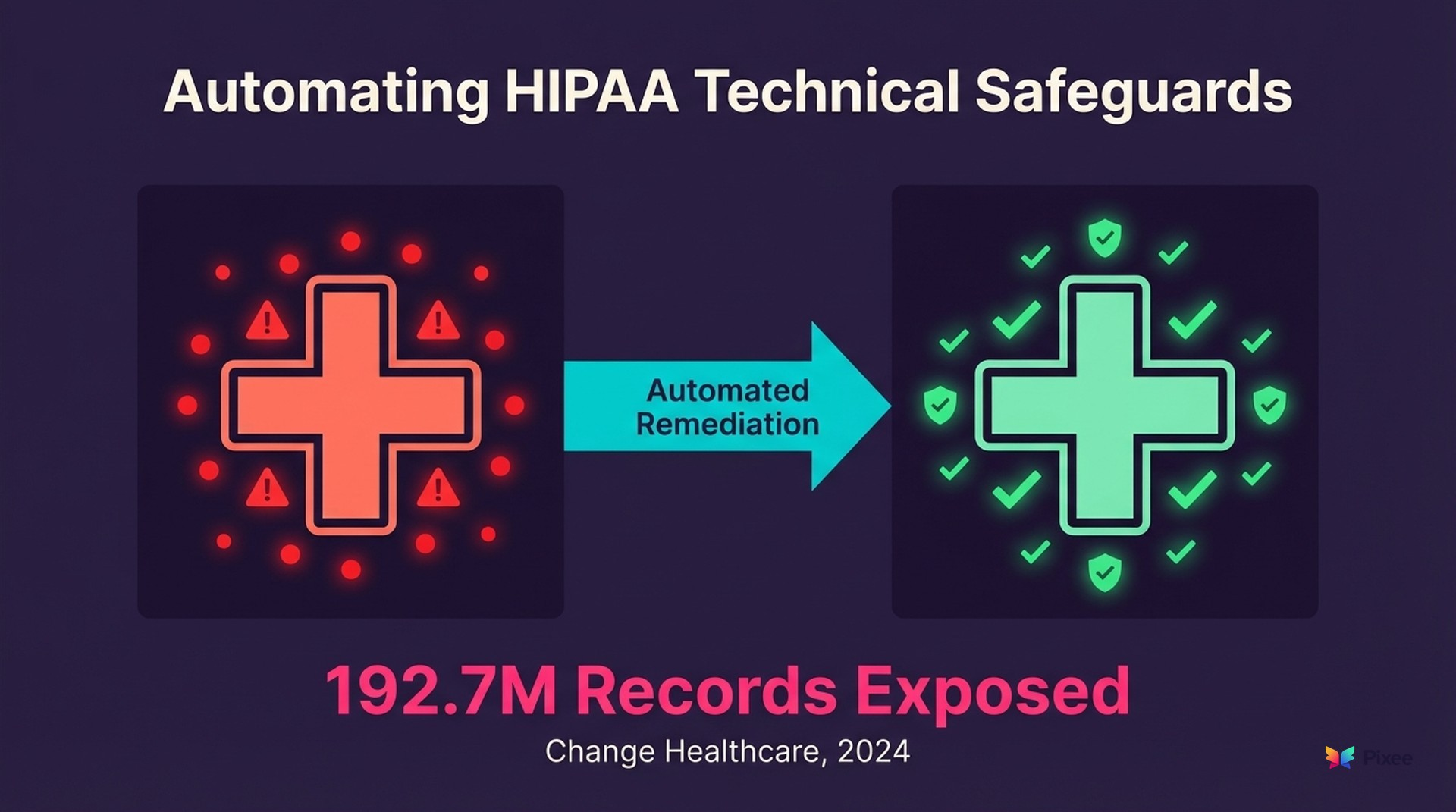
In February 2024, the Change Healthcare ransomware attack exposed 192.7 million patient records, the largest healthcare data breach in U.S. history (HIPAA Guide, 2025). The attack exploited compromised credentials on a Citrix portal where MFA was not enabled. A known, preventable vulnerability. The cost to UnitedHealth Group reached $2.457 billion.
The operational cascade disrupted the entire U.S. healthcare payment system. 94% of hospitals reported financial impact, and providers were unable to submit claims for weeks (AHA survey). That single breach became the catalyst for the January 2025 proposed HIPAA Security Rule overhaul.
HIPAA's Security Rule (Section164.312) requires technical safeguards for electronic protected health information. In practice, this means healthcare organizations must demonstrate that application vulnerabilities are identified, prioritized, and remediated within timeframes that prevent unauthorized PHI exposure.
Most healthcare security teams can demonstrate scanning. Fewer can demonstrate consistent remediation. And almost none can demonstrate both while keeping all code and vulnerability data inside controlled infrastructure, which HIPAA's minimum necessary standard and many organizational policies require.
Most organizations carry 100,000+ open vulnerabilities with a 252-day mean time to remediation (Veracode State of Software Security, 2025). Healthcare organizations face these same numbers with the additional constraint that solutions requiring code to leave the network may violate their own data handling policies. The financial stakes are sector-specific. The average healthcare data breach costs $7.42 million, and healthcare has been the costliest industry for 14 consecutive years (HIPAA Journal, 2025). Ransomware incidents add estimated downtime costs of $900,000 per day (Comparitech, 2025).
What Section164.312 Requires in Practice
HIPAA's technical safeguard requirements map to vulnerability management at several points:
Access Control (Section164.312(a)(1)). Systems containing PHI must prevent unauthorized access. Application vulnerabilities that bypass authentication, authorization, or session management directly threaten this safeguard. Evidence of timely remediation demonstrates control effectiveness.
Audit Controls (Section164.312(b)). Organizations must implement mechanisms to record and examine activity. For vulnerability management, this means documented triage decisions, timestamped remediation records, and traceable fix-to-finding linkage.
Integrity Controls (Section164.312(c)(1)). Organizations must protect ePHI from improper alteration or destruction. Application vulnerabilities like SQL injection, insecure deserialization, and path traversal directly threaten data integrity. Automated remediation that addresses these vulnerability classes supports this safeguard.
Transmission Security (Section164.312(e)(1)). Where ePHI is transmitted electronically, technical security measures must guard against unauthorized access. Vulnerabilities in API endpoints, data serialization, and transport layer configurations fall under this requirement.
The Regulatory Floor Is Rising
The current HIPAA Security Rule uses "required" versus "addressable" implementation specifications. Many organizations have historically treated "addressable" as optional. That loophole is closing.
The HHS Notice of Proposed Rulemaking (NPRM), published January 6, 2025, proposes significant hardening. The most consequential changes for vulnerability management follow.
All specifications become required. The "addressable" designation is eliminated. No more arguing that MFA or encryption is optional (Coalfire, 2025).
Mandatory patch timelines. Critical vulnerabilities must be patched within 15 calendar days. High-risk vulnerabilities within 30 calendar days (ManageEngine, 2025). For organizations managing thousands of findings across dozens of repositories, these timelines make manual-only remediation mathematically difficult.
Scanning and testing cadence. Vulnerability scanning at least every 6 months. Penetration testing at least every 12 months (HHS NPRM Fact Sheet).
MFA and encryption mandatory. MFA for all ePHI system access. AES-256 encryption at rest, TLS 1.3 in transit (Cyera, 2025; Censinet, 2025).
An important caveat. The proposed rule is not yet final. A January 31, 2025 executive order placed a regulatory freeze on new rules, and as of March 2026, the current Security Rule remains in effect (Barr Advisory, 2026). The rule received 4,000+ public comments, and political dynamics create genuine uncertainty about whether it will be finalized in its current form.
But the enforcement trend is clear regardless of the NPRM's fate. OCR's Risk Analysis Initiative, launched in late 2024, has produced 11 enforcement actions by early 2026, all targeting organizations that failed to conduct adequate security risk analyses (Ogletree, 2026). In 2026, OCR confirmed it will expand this initiative to also cover risk management, meaning organizations must demonstrate they are actively remediating identified vulnerabilities, not just cataloging them (HIPAA Journal, 2026). Risk analysis failure is the single most common HIPAA Security Rule violation in OCR investigations. Settlements like Premera Blue Cross ($6.85 million) and Excellus Health Plan ($5.1 million) demonstrate the financial consequences.
The direction is unmistakable: identify vulnerabilities AND prove you are fixing them, on a timeline, with evidence.
Where Healthcare Security Programs Stall
Healthcare security teams hit three walls that general enterprise teams do not.
Air-gapped and hybrid environments. Many healthcare organizations operate in environments where code and vulnerability data cannot traverse public networks. Cloud-only security tools are architecturally incompatible with these environments. When your remediation platform requires sending code to an external cloud API, it fails the minimum necessary test before evaluation begins.
PHI-adjacent codebases. Applications that process, store, or transmit PHI carry heightened scrutiny. Automated remediation tools that analyze code context must do so without exposing PHI or PHI-adjacent data to external systems. Self-hosted deployment is not a preference. It is a compliance requirement for many healthcare organizations.
Resource-constrained security teams. 53% of healthcare organizations say they lack in-house cybersecurity expertise, and nearly half report insufficient IT staffing overall (Enoma Ojo, 2025). Healthcare allocates 4-7% of its IT budget to cybersecurity, compared to roughly 15% in financial services (HIMSS, 2025). Twenty percent of healthcare organizations have no specific cybersecurity carve-out in their IT budget at all (IANS Research, 2025).
Manual triage of thousands of scanner findings competes with incident response, audit preparation, and security architecture work. When up to 80% of triage time goes to investigating false positives (Ponemon Institute, 2024), the impact is outsized for teams that are already understaffed.
Ransomware as the operational consequence. Healthcare is under direct, sustained attack. In 2025, 445 ransomware attacks targeted hospitals, clinics, and direct care providers (up from 437 in 2024), with an additional 191 attacks on healthcare businesses like billing and pharma, a 25% increase year-over-year (Comparitech, 2025). According to HHS, unpatched software vulnerabilities caused nearly 1 in 5 of these healthcare ransomware attacks.
One in three U.S. hospitals has experienced a cybersecurity breach that disrupted patient care (Censinet, 2025). Vulnerability remediation is not an abstract compliance exercise in healthcare. It is directly connected to the threat these organizations fear most.
How Automated Remediation Supports HIPAA Compliance
With nearly 1 in 5 healthcare ransomware attacks traced to unpatched vulnerabilities (HHS NPRM Fact Sheet), and OCR now investigating not just whether organizations identify risks but whether they are actively managing them, automated triage and remediation address healthcare-specific constraints directly.
Triage Automation: Signal From Noise
Before any remediation begins, exploitability analysis achieves 95% false positive reduction, measured by comparing scanner-reported findings against exploitability-confirmed findings using reachability and control analysis (Pixee Platform Data, 2025). Reachability analysis maps whether vulnerable code is callable from application entry points. Security control detection identifies existing protections (input validation, authentication checks, WAF rules) that reduce the practical exploitability of a finding. This analysis informs prioritization but does not guarantee protection; control effectiveness should be validated through testing, not assumed.
For healthcare teams, this can mean reviewing roughly 100 genuine vulnerabilities instead of 2,000 scanner alerts, freeing time for the audit preparation and incident response work that cannot be automated.
Remediation Automation: Fixes That Match Your Standards
For each confirmed vulnerability, automated remediation generates context-aware pull requests matching your codebase conventions. Fixes include breaking change detection with 80-90% confidence scoring. Developers review and merge, maintaining the human oversight that compliance requires while eliminating the manual coding burden.
A 76% merge rate (defined as PRs merged without modification within 72 hours of opening, measured across 100,000+ PRs from enterprise deployments; Pixee Platform Data, 2025) reflects fixes that meet developer standards, not suggestions that require rework.
Self-Hosted Deployment: Code Stays Inside Your Network
For healthcare organizations requiring on-premise or VPC deployment, Pixee operates within your infrastructure. Code analysis, triage decisions, and fix generation all happen inside your controlled environment.
Note: Full air-gap capability (zero external network calls) depends on self-hosted LLM configuration. Organizations should evaluate their specific network boundary requirements during implementation planning.
Business Associate Agreements
In a self-hosted deployment, Pixee's analysis engine runs entirely within your infrastructure. No code, findings, or PHI-adjacent data leaves your environment. This architecture may reduce or eliminate BAA requirements by preventing Pixee from accessing protected information. Organizations should verify this assessment with their own privacy counsel, as BAA determinations depend on the specific deployment configuration and data flows.
Audit-Ready Evidence Trail
Every triage decision and remediation action generates timestamped, attributable records:
This evidence chain supports Section164.312(b) audit control requirements without manual documentation effort. It also directly addresses OCR's Risk Analysis Initiative, which expanded in 2026 to cover risk management. Auditors now ask not just "did you identify this vulnerability?" but "what did you do about it, and when?" The timestamped triage-to-fix chain provides exactly the evidence OCR looks for.
What Automation Does Not Solve
Automated remediation supports HIPAA compliance. It is not a standalone compliance solution, and healthcare CISOs should evaluate it with clear eyes.
Legacy clinical systems resist automation. Medical devices and clinical systems often run outdated OS versions that cannot be easily patched. Automated code remediation applies to modern application codebases, not to legacy systems that require manual remediation approaches and compensating controls.
Business logic and patient safety require human judgment. Clinical application changes require testing against patient safety workflows. A dependency update that breaks an EHR integration can have life-safety consequences. The human-in-the-loop model (developers review and merge every fix) is specifically designed for this, but it means automation complements clinical change management processes rather than replacing them.
The proposed HIPAA rule may not become final. The January 2025 regulatory freeze and political dynamics create genuine uncertainty. Organizations should plan for the enforcement trend (which is happening regardless) without over-indexing on specific proposed requirements that may change.
Small organizations face different ROI math. Healthcare organizations with small codebases and limited development teams may not see the same return from automated remediation as large health systems. The cost of not remediating ($7.42 million average breach) dwarfs tool costs, but the operational maturity to adopt automation varies.
Implementation Considerations for Healthcare
Start with non-PHI systems. Validate remediation quality and workflow integration on non-PHI codebases before expanding to PHI-processing applications. This reduces risk while building team confidence.
Verify deployment architecture. Confirm that the self-hosted deployment model meets your organization's specific network boundary requirements. Engage your security architecture team during evaluation.
Maintain human oversight. Automated remediation generates fixes. Developers review and merge. This human-in-the-loop model satisfies both the technical competence requirement and organizational change management policies.
Document the compliance mapping. Map automated remediation capabilities to specific Section164.312 requirements in your security documentation. This accelerates future audits by establishing the control-to-evidence linkage upfront.
Start with your vendor risk assessment process. Determine whether a self-hosted deployment model eliminates BAA requirements for your environment, then evaluate against your open vulnerability inventory.
See How It Works in a Healthcare Context
Book a demo to discuss deployment architecture for healthcare environments. We will walk through self-hosted deployment options, evidence generation for HIPAA audits, and integration with your existing scanner stack.
Related Reading:
Related Resources