Why You Shouldn't Buy a Security Product in Response to React2Shell

The dust is starting to settle in the aftermath of React2Shell. On December 3, 2025, the React team disclosed CVE-2025-55182—a perfect CVSS 10.0 vulnerability that enables unauthenticated remote code execution in React Server Components. The initial panic has subsided. Most organizations have patched their deployments or are well on their way to doing so. Security vendors have released their WAF rules and virtual patches. Cloudflare's emergency mitigation even triggered a global outage in the rush to protect customers. The familiar cycle has largely played out.
But now, as 2025 draws to a close and organizations finalize their 2026 security budgets, a quieter but more consequential cycle is beginning. Vendor pitches are being prepared. Sales calls are happening. Budget line items are being justified with references to React2Shell and the need to prevent "the next one." Security products are being sold on the promise that they'll help organizations respond faster to the next critical vulnerability.
Here's the uncomfortable truth: if your security strategy for 2026 is to buy a new product because React2Shell happened in 2025, you're solving the wrong problem.
The Real Problem Isn't React2Shell
React2Shell is undeniably serious. A CVSS 10.0 vulnerability enabling unauthenticated RCE in a library with 60 million weekly npm downloads deserves immediate attention. And it's getting that attention—probably more attention than any other vulnerability this year.
The vulnerability sits in React's "Flight" protocol, which handles deserialization of server component payloads. An attacker can craft a malicious payload that, when processed by the server, executes arbitrary code. Sophisticated threat actors were observed exploiting it within hours of disclosure, deploying Mirai botnets and cryptocurrency miners. Active exploitation is happening, and it's real.
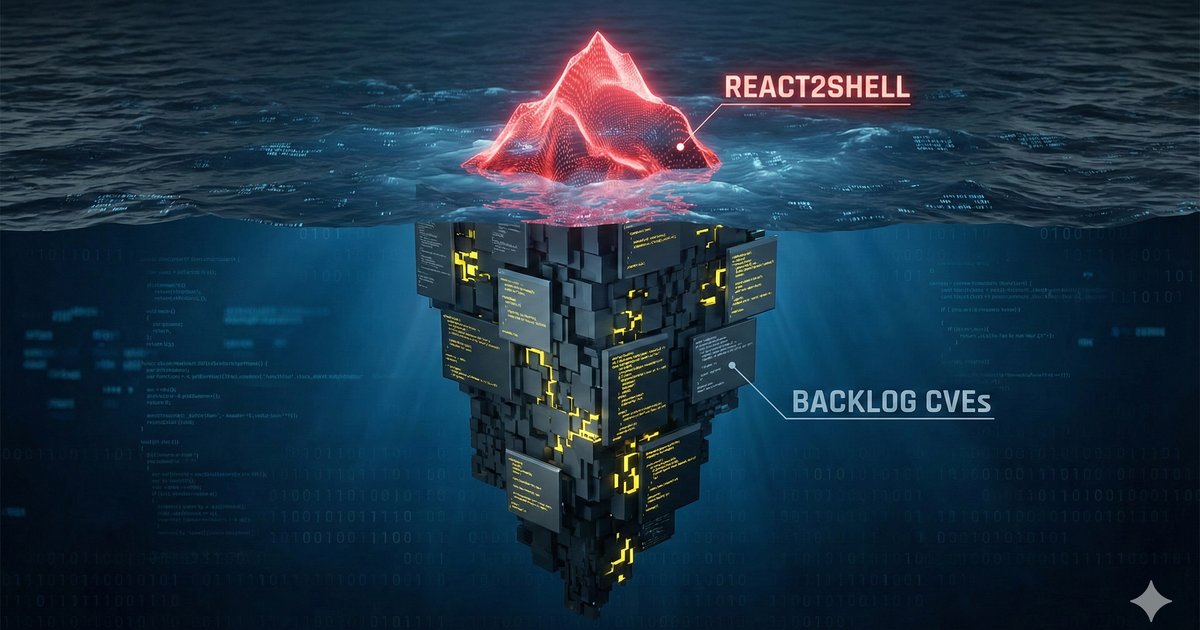
But while we're all focused on this one spectacular CVE, what's happening to the hundreds of other vulnerabilities in your application's dependency tree? The medium and high severity CVEs that don't get catchy names, don't spawn dedicated websites, and don't trigger vendor marketing campaigns?
These vulnerabilities collectively account for the majority of your daily risk exposure. They're sitting in your security team's backlog, growing older by the day. Some of them are actively exploitable. Most aren't, but the problem is you don't know which is which without doing the hard work of understanding your application's specific attack surface.
The industry's obsession with spectacular vulnerabilities creates a false sense of security. We've trained ourselves to respond to the signal flares while ignoring the slow burn in the background. React2Shell will be patched in most organizations within days or weeks because it has visibility, urgency, and organizational buy-in. But what about CVE-2024-XXXXX in that obscure parsing library three layers deep in your dependency tree? That one sits in Jira for months, marked "medium priority," waiting for someone to have time to investigate whether it's actually exploitable in your specific configuration.
Over-Indexing on High-Visibility CVEs
React2Shell doesn't suffer from an attention problem. It doesn't need a new security product to get prioritized. Most engineering teams know about it and are tracking it. The visibility is the vulnerability's own mitigation mechanism; it will get fixed because it can't be ignored.
This is the fundamental mismatch between vendor solutions and actual security needs. The security products being sold in response to React2Shell are optimized for a problem that doesn't exist: insufficient awareness and prioritization of this specific vulnerability. The real problem is the inverse: we have infinite CVEs and finite attention. We need help identifying which of the thousands of medium and high severity vulnerabilities in our backlog deserve the same level of urgency as React2Shell.
When we over-index on solutions for high-visibility CVEs, we're optimizing for the outliers. It's like buying an umbrella specifically designed for Category 5 hurricanes when what you really need is something that works in regular rain. React2Shell and Log4Shell, and the next branded vulnerability will get handled because they must. The question is: what happens to everything else?
What Actually Works: Patch and Release
The only real fix for React2Shell is the same as it's always been: upgrade to the patched version. React released fixed versions on December 3rd. Next.js followed immediately. The remediation path is clear, well-documented, and thoroughly tested by the maintainers.
WAF rules might seem like a quick win, but they come with significant limitations that are well-documented in security research. Bypassing signature-based detection for deserialization vulnerabilities is a cat-and-mouse game that attackers consistently win. The techniques are publicly known: encoding variations, protocol abuse, timing-based attacks, and fragmentation. For every WAF signature that blocks a payload pattern, there's a researcher working on a bypass. Cloudflare's outage-inducing emergency rules are a case study in why runtime detection of complex vulnerabilities is harder than it looks.
There's another important consideration: the React2Shell researcher himself warned about invalid PoCs circulating in the wild. Many supposed "proof of concepts" require developers to have explicitly exposed dangerous functionality like vm.runInThisContext, child_process.exec, or fs.writeFile to clients, which would be dangerous regardless of this vulnerability. These fake PoCs have been referenced in publications and vulnerability aggregators, potentially leading to false negatives in security assessments. If your WAF is tuned to block these invalid exploitation patterns, you might have a false sense of security while remaining vulnerable to the genuine attack vector.
More fundamentally, a WAF is a band-aid, not a cure. It might buy you time, but it shouldn't replace patching. Every day you run vulnerable code in production, you're accepting risk that doesn't need to exist. The patch is available. The testing frameworks exist. The deployment pipelines are already in place. Just fix it.
The Tools Your Developers Already Use
Here's the good news: you probably already have the infrastructure to handle this entire class of problems. If you're running a modern development workflow, you're likely using Dependabot, Renovate Bot, or similar automated dependency update tools. These tools don't care if a vulnerability is named React2Shell or CVE-2024-XXXXX. They don't care if it has a CVSS of 10.0 or 6.5. They simply track available updates and create pull requests.
This is the unsexy, unglamorous reality of effective vulnerability management: automated dependency updates plus good testing plus fast deployment pipelines. No new product required. No emergency purchases. No vendor calls. Just the boring, reliable practice of keeping your dependencies current.
The workflow is straightforward:
1. Renovate Bot opens a PR upgrading React from 19.0.0 to 19.0.1
2. Your CI pipeline runs automated tests
3. Tests pass, PR gets merged
4. Changes are deployed through your normal pipeline
5. Vulnerability is remediated
This same workflow handles React2Shell, the next critical vulnerability, and the hundred mundane security updates in between. It's consistent. It doesn't require emergency meetings or rushed deployments, or new vendor relationships.
The Haystack Problem
The security problem that keeps me up at night isn't "how do I protect against the next React2Shell?" It's "how do I find the few truly dangerous vulnerabilities hiding among the thousands of CVEs reported for an application?"
Most CVEs fall into a few categories:
• Not exploitable in any realistic scenario
• Exploitable only in extremely specific configurations you don't use
• Exploitable in theory, but requires local access or authentication you've already protected
• Actually dangerous in your specific deployment
The challenge is classification. When Dependabot opens 47 PRs in a single day, how do you know which three need immediate attention and which 44 can wait for the next sprint? This is where security teams need help—not with responding to the obvious 10.0 CVSS vulnerabilities that everyone is already handling, but with triaging the murky middle.
Let me give you a concrete example. Imagine your application has these vulnerabilities in its backlog:
• CVE-2024-XXXXX (CVSS 7.5) - Path traversal in a file upload library. Sounds serious, but your application doesn't expose file upload functionality to untrusted users. False alarm.
• CVE-2024-YYYYY (CVSS 6.8) - SQL injection in an ORM. Concerning, but you're using parameterized queries everywhere, and the vulnerable code path isn't reachable from user input. Low priority.
• CVE-2024-ZZZZZ (CVSS 6.1) - XSS in a template rendering library. Your application uses this library extensively in user-facing pages. This one actually matters, but it got deprioritized because the CVSS is "only" 6.1.
Without context about your actual architecture and data flow, you can't make these distinctions. You're left either patching everything (impossible at scale) or making educated guesses based on CVSS scores (which don't capture your specific risk profile).
This is the haystack problem, and it's fundamentally about context. Is this vulnerability in code you actually execute? Is it reachable from an attack vector you care about? Is it exploitable given your specific configuration? These questions require a deep understanding of your application architecture, deployment model, and threat landscape. They can't be answered by a generic WAF rule or a vendor dashboard that just shows you CVE counts and severity scores.
The industry needs better tools for this problem—tools that understand your application's dependency graph, runtime behavior, and actual attack surface. Tools that can tell you "this CVE affects code you don't execute," or "this vulnerability is exposed on your internet-facing API," or "this exploit requires local file access, which your container configuration prevents." This is where the real security engineering work happens, in the gap between published vulnerability and contextual risk.
Conclusion
React2Shell is serious. Fix it. Upgrade to the patched versions of React and Next.js. Test your deployment. Set up monitoring for exploitation attempts as an additional layer of defense. But don't let this vulnerability distract you from the harder, more important work of systematic vulnerability management.
Don't buy a new security product because of React2Shell. You don't need one. The vulnerability is getting plenty of attention without it. Instead, invest in:
• Automated dependency management - If you're not using free tools like Renovate Bot or Dependabot, start today
• Fast testing and deployment pipelines - The faster you can ship updates, the smaller your exposure window
• Culture of continuous updates - Making dependency updates a normal part of development, not an emergency response
• Focus on the backlog - Systematically working through those medium and high severity CVEs that have been sitting in Jira for months
The next branded, high-visibility vulnerability is already being discovered by some researcher. When it drops, the cycle will repeat: fear, vendor marketing, rushed deployments, then back to ignoring the backlog. Break the cycle. Build systems that handle vulnerabilities systematically, not theatrically.
The real security challenge isn't stopping the next React2Shell. It's finding the signals in the noise, prioritizing correctly, and maintaining the discipline to keep patching even when the vulnerability doesn't have a clever name.
At Pixee, we're focused on helping engineering teams move from reactive to systematic security. If you're interested in better approaches to vulnerability management that work for your entire backlog, not just the headlines, we'd love to talk.
Related Resources