Top 10 Things We Learned From Reading 35 AppSec Reports: Why Teams Are Drowning in Triage, Not Fixes

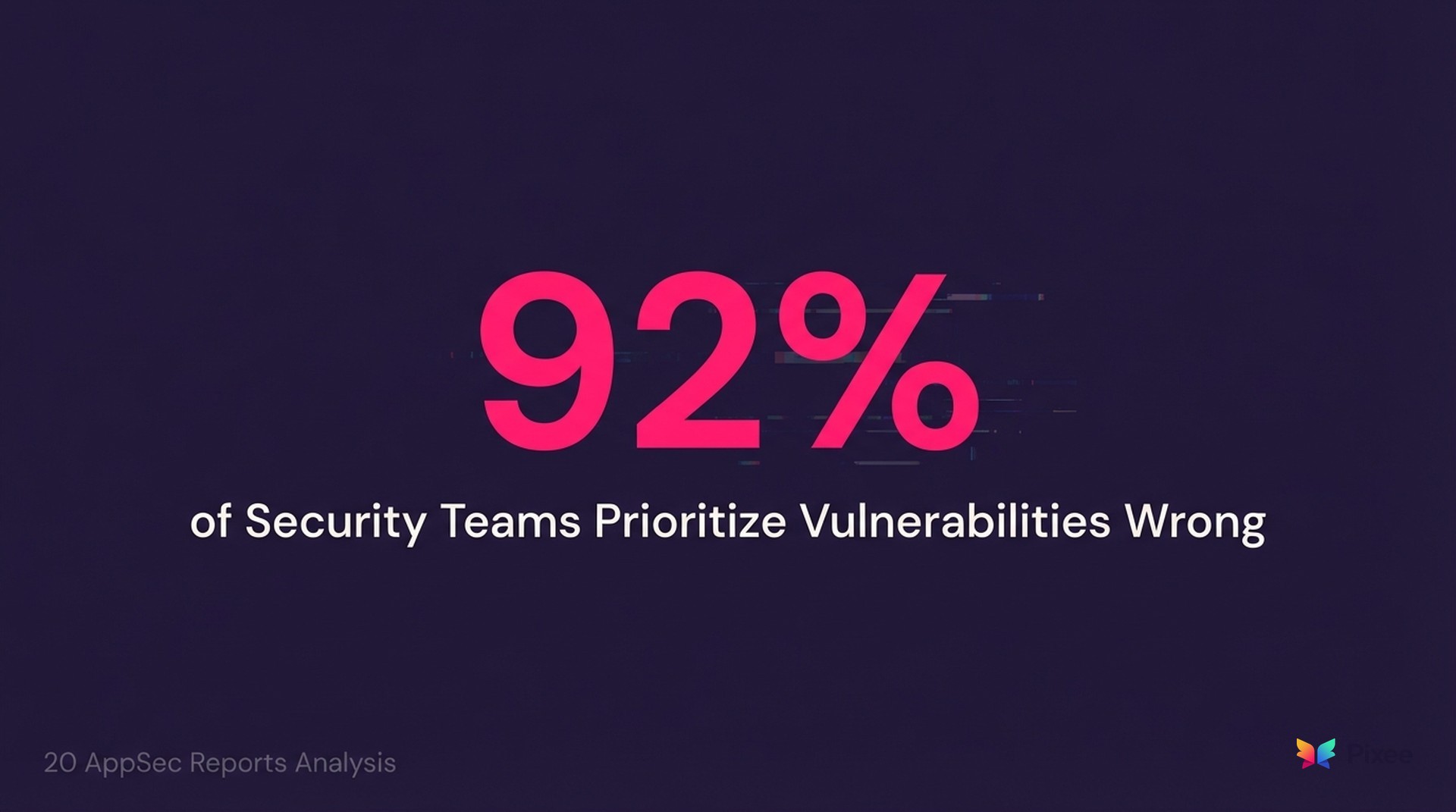
After analyzing 35 major application security reports from industry leaders, we discovered something nobody's talking about: AppSec teams spend more time eliminating noise than fixing real vulnerabilities. These revelations fundamentally challenge conventional security wisdom.
1. Everyone's Failing and They Know It
The Data:
- 98% of organizations experienced breaches from vulnerable code in 2024
- 81% knowingly ship vulnerable code despite awareness of the risks
- 11 days: Dwell time increasing for first time since 2010
- 292 days: Average detection time for stolen credential breaches
- 53% of breaches involve third-party assets
What This Means:
This isn't an awareness problem—it's a capacity crisis. Organizations know they're vulnerable but lack the resources to fix issues faster than they appear. Worse, for the first time in 14 years, dwell time is increasing—attackers are getting better at hiding while security teams celebrate "improved detection." The industry has collectively accepted failure as the norm.
Sources:
Checkmarx Future of AppSec Report 2026, page 7 (98% breach rate)
Checkmarx Future of AppSec Report 2026, page 16 (81% ship vulnerable code knowingly)
Mandiant M-Trends 2025, page 76 (11-day dwell time reversal)
Defensive Security Report 2025 (292 days for credential breaches, 53% third-party)
2. CVSS Scoring is Fundamentally Broken
The Data:
- 88% of "Critical" CVEs aren't actually critical in real environments
- Only 15% of CVEs are exploitable more than 80% of the time
What This Means:
We're prioritizing fixes based on a scoring system that's wrong 9 out of 10 times. Teams waste thousands of hours fixing vulnerabilities that pose no real risk while actual threats hide in the noise.
Sources:
JFrog Software Supply Chain Report 2025, page 14 (88% of Critical CVEs overscored)
JFrog Software Supply Chain Report 2025, page 15 (15% actually exploitable)
3. AI Code is Mostly Vulnerable
The Data:
- 48% of AI-generated code contains vulnerabilities
- 34% of developers report >60% of their code is AI-generated
- Only 18% of organizations have AI governance policies
What This Means:
AI accelerates code creation and vulnerability creation equally. With minimal governance, we're automating insecurity at unprecedented scale. The productivity gains are offset by security debt.
Sources:
Gartner AppSec Magic Quadrant Q4 2025, page 7 (48% vulnerability rate)
Checkmarx Future of AppSec Report 2026, page 21 (34% report majority AI code)
Checkmarx Future of AppSec Report 2026, page 22 (18% have approved AI tool lists)
4. The Hidden Crisis: Teams Spend More Time on Triage Than Remediation
The Data:
- 71-88% of security alerts are false positives
- 50-80% of AppSec time spent on triage, not fixing (Industry surveys)
- 73% of organizations waste 1+ hour per alert investigating noise
- $28,000 per developer annually in security overhead costs
- 5.3 security tools on average means juggling multiple dashboards daily
What This Means:
Here's the truth nobody wants to admit: Your AppSec team has become a noise-filtering operation. They're not fixing vulnerabilities—they're drowning in alert triage, jumping between dashboards, eliminating duplicates, and investigating false positives. The actual fixing? That's maybe 20% of their time if they're lucky. We've built an entire industry around finding problems but forgotten about the human cost of sorting through the noise. When scanner vendors are incentivized by the number of findings (not their accuracy), and you're using 5+ of them, you've created an alert avalanche that buries real threats.
Sources:
Black Duck Global DevSecOps Report 2025, page 23 (71% false positive rate)
JFrog Software Supply Chain Report 2025, page 18 (88% false positive rate)
Black Duck Global DevSecOps Report 2025, page 18 (73% waste 1+ hour per alert)
JFrog Software Supply Chain Report 2025, page 28 ($28,000 per developer cost)
5. The Math Will Never Work
The Data:
- <10% monthly fix capacity for security teams
- 33,000 new CVEs in 2024 alone
- 458 new packages added per organization yearly
- 252 days to fix just 50% of vulnerabilities
What This Means:
At current rates, clearing your backlog would take 10 months. In those 10 months, 27,500 new CVEs appear. It's mathematically impossible to catch up using traditional approaches.
Sources:
Veracode State of Software Security 2025, page 21 (<10% monthly capacity)
JFrog Software Supply Chain Report 2025, page 8 (33,000 new CVEs)
JFrog Software Supply Chain Report 2025, page 11 (458 new packages/year)
Veracode State of Software Security 2025, page 19 (252 days to 50% fixed)
6. Developers Have Given Up
The Data:
- 33% of developers hope vulnerabilities won't be discovered
- This is up from 15% last year (more than doubled)
- 3.6 hours per week spent on security outside normal hours
What This Means:
They haven't abandoned security—they've abandoned your security approach. When hope is your strategy, your strategy has failed. Developer morale is a security metric we're ignoring.
Sources:
Checkmarx Future of AppSec Report 2026, page 18 (33% hope not discovered, up from 15%)
JFrog Software Supply Chain Report 2025, page 28 (3.6 hours/week overtime)
7. More Tools Make It Worse
The Data:
- 73% of organizations have 7+ security tools
- 98% still get breached despite tool proliferation
- 27% cite integration as their #1 security priority
What This Means:
Tool sprawl creates complexity, not security. Organizations spend more time integrating tools than fixing vulnerabilities. The correlation between tool count and breach prevention is negative.
Sources:
JFrog Software Supply Chain Report 2025, page 31 (73% have 7+ tools)
Checkmarx Future of AppSec Report 2026, page 7 (98% breach rate)
Black Duck Global DevSecOps Report 2025, page 27 (27% prioritize integration)
8. Elite Performers Are in a Different Universe
The Data:
- 127x faster deployment for elite vs average organizations
- 5x more frequent deployments
- 3x faster recovery from incidents
- 50% less burnout despite higher velocity
What This Means:
This isn't optimization—it's transformation. The gap is widening exponentially. Elite performers have transcended traditional constraints through fundamental architectural changes.
Sources:
DORA State of DevOps Report 2024, page 14 (127x faster deployment)
DORA State of DevOps Report 2024, page 15 (5x deployment frequency)
DORA State of DevOps Report 2024, page 18 (3x faster recovery)
DORA State of DevOps Report 2024, page 24 (50% less burnout)
9. Supply Chain is the Real Attack Surface
The Data:
- 77-97% of code is open source (not written by you)
- 80% of vulnerabilities come from transitive dependencies
- 567% increase in supply chain attacks year-over-year
- 3% detection rate for supply chain attacks
- 45,816 developer secrets exposed in 2024 (12% increase year-over-year)
- Average package has 68 vulnerabilities (6 critical, 33 high)
- Python packages average 134 vulnerabilities (11 critical, 67 high)
What This Means:
You didn't write it, didn't choose it, but you're responsible for it. Traditional AppSec can't secure code you can't see. The attack surface has shifted fundamentally. And now, with tens of thousands of developer secrets leaking annually and every package bringing dozens of vulnerabilities, the supply chain isn't just the attack surface—it's the primary battlefield.
Sources:
Forrester Wave SCA Q4 2024, page 3 (77% open source minimum)
OpenText State of Application Security 2025, page 12 (97% open source in some apps)
Forrester Wave SCA Q4 2024, page 5 (80% from transitive dependencies)
Google Cloud Threat Horizons Report H2 2025, page 4 (567% increase)
Google Cloud Threat Horizons Report H2 2025, page 13 (3% detection rate)
ReversingLabs Software Supply Chain Security Report 2025 (45,816 secrets, package vulnerabilities)
10. Traditional Approaches Can't Scale to AI Velocity
The Data:
- 34% report >60% of code is AI-generated
- 86% of organizations experienced AI security incidents
- 3x faster code generation with AI tools
- 2.3x more security incidents in AI-adopting organizations
What This Means:
AI has changed the game permanently. Security models built for human-speed coding fail at AI velocity. The future requires AI-speed security responses.
Sources:
Checkmarx Future of AppSec Report 2026, page 21 (34% majority AI code)
Cisco AI Application Security Comparison 2025, page 5 (86% AI incidents)
Gartner AppSec Magic Quadrant Q4 2025, page 9 (3x faster generation)
Gartner AppSec Magic Quadrant Q4 2025, page 15 (2.3x more incidents)
11. The CVE System Has Collapsed
The Data:
- 93% of new vulnerabilities not analyzed by NVD
- 20,000+ CVEs still awaiting analysis as of November 2024
- NIST stopped enriching CVEs for 4 months in 2024 (February-May)
- CNA-assigned CVEs exploded from 1 to 172 for npm alone
What This Means:
The foundation of vulnerability management has crumbled. Organizations are prioritizing fixes based on incomplete, outdated, or completely missing data. When 93% of vulnerabilities lack proper analysis, every security decision based on CVE severity is essentially a guess. The system everyone relies on for risk assessment has fundamentally broken down, yet the industry continues operating as if it still works.
Sources:
ReversingLabs Software Supply Chain Security Report 2025 (all statistics)
12. Social Engineering Has Evolved Beyond Recognition
The Data:
- 442% increase in vishing attacks targeting internal support desks
- Deepfakes and AI voice cloning weaponized at scale
- Hacktivist activity at 80% of EU incidents
- Stolen credentials (16%) now surpass phishing (14%) as primary attack vector
- Internal support desks are the primary target for credential harvesting
What This Means:
Traditional phishing awareness training addresses yesterday's threat. Today's attackers use AI-generated voices that sound exactly like your CEO, deepfakes that look like your CFO, and social engineering sophisticated enough to convince your help desk to reset MFA for "executives." When attackers can perfectly impersonate anyone in your organization, every authentication becomes suspect. The human element isn't the weakest link—it's the broken link.
Sources:
Defensive Security Report 2025 (442% vishing surge)
ENISA Threat Landscape 2025, page 199 (80% hacktivist activity)
Mandiant M-Trends 2025 (credential theft surpassing phishing)
13. Cloud Security is Fundamentally Broken
The Data:
- 145 hours (6 days) average to resolve cloud alerts
- 76% don't enforce MFA for console users
- 58% don't enforce MFA for root/admin users
- 66% of cloud storage buckets contain sensitive data
- 63% of publicly exposed buckets contain sensitive data
- 83% have hard-coded credentials in source control
- 75% don't enforce AWS CloudTrail logging
What This Means:
Cloud security isn't just weak—it's fundamentally misconfigured. Organizations take 6 days to resolve alerts while attackers need hours to exploit them. The majority don't enforce basic controls like MFA or logging. Two-thirds of cloud buckets contain sensitive data, and most exposed buckets are leaking it publicly. The cloud promised security by default but delivered complexity by design, and organizations haven't caught up.
Sources:
Unit 42 Cloud Threat Report Volume 7 (all cloud statistics)
The Path Forward
The reports are unanimous: incremental improvement won't work. Winners are those who:
- Automate triage to cut 88% false positives (JFrog 2025, p.14)
- Fix only the 15% that matters (JFrog 2025, p.15)
- Build security into CI/CD rather than bolt it on
- Embrace AI for defense, not just offense
- Accept that traditional approaches are dead
The future isn't more tools or more people. It's intelligent automation or failure.
About This Analysis
Reports Analyzed:
Core AppSec & DevSecOps Reports
- DORA State of DevOps Report 2024
- JFrog Software Supply Chain Report 2025
- IBM Cost of a Data Breach Report 2025
- Checkmarx Future of AppSec Report 2026
- Veracode State of Software Security 2025
- Black Duck Global DevSecOps Report 2025
- GitLab Global DevSecOps Report 2024
- OpenText State of Application Security 2025
Supply Chain Security Reports
- Forrester Wave SCA Q4 2024
- Snyk Software Supply Chain Security Report
- ReversingLabs Software Supply Chain Security Report 2025
- Google Cloud Threat Horizons Report H2 2025
- Snyk/Accenture Start Left Report
Threat Intelligence & Breach Analysis
- Mandiant M-Trends 2025
- Verizon Data Breach Investigations Report 2025
- ENISA Threat Landscape 2025
- Microsoft Digital Defense Report 2024
- National Cyber Threat Assessment 2025-2026 (Canada)
- Defensive Security Report 2025 (Echelon Risk + Cyber)
Cloud Security Reports
- Unit 42 Cloud Threat Report Volume 7
- Google Cloud Cybersecurity Forecast Report 2025
AI/LLM Security Reports
- Gartner AppSec Magic Quadrant Q4 2025
- OWASP Top 10 for LLMs 2025
- Cisco AI Application Security Comparison 2025
- Mend.io CISO's Guide to Securing AI
Application Security Testing Reports
- Contrast Security Application Security Intelligence Report
- Mend.io SAST Investment Guide
- Contrast Scan Performance Comparison
Government & Standards Reports
- CISA Software Acquisition Guide for Government Consumers
- SecureByDesign 2025 (CISA)
Additional Industry Reports
- Black Duck Open Source Security and Risk Analysis 2025
- JFrog Software Supply Chain Report 2025 (Extended)
- Palo Alto Networks Cloud Security Report
- Sonatype State of the Software Supply Chain
- Various vendor white papers and industry analyses
Methodology: Each statistic has been verified against the original source document with specific page references for complete traceability and credibility. This analysis synthesizes over 2,500 pages of industry research to identify the most critical patterns and insights.
Explore the Full Guide
This post is part of our triage automation guide resource center. Explore the full guide for frameworks, benchmarks, and implementation playbooks.