8 Forces Making On-Premises AI Remediation Urgent Now

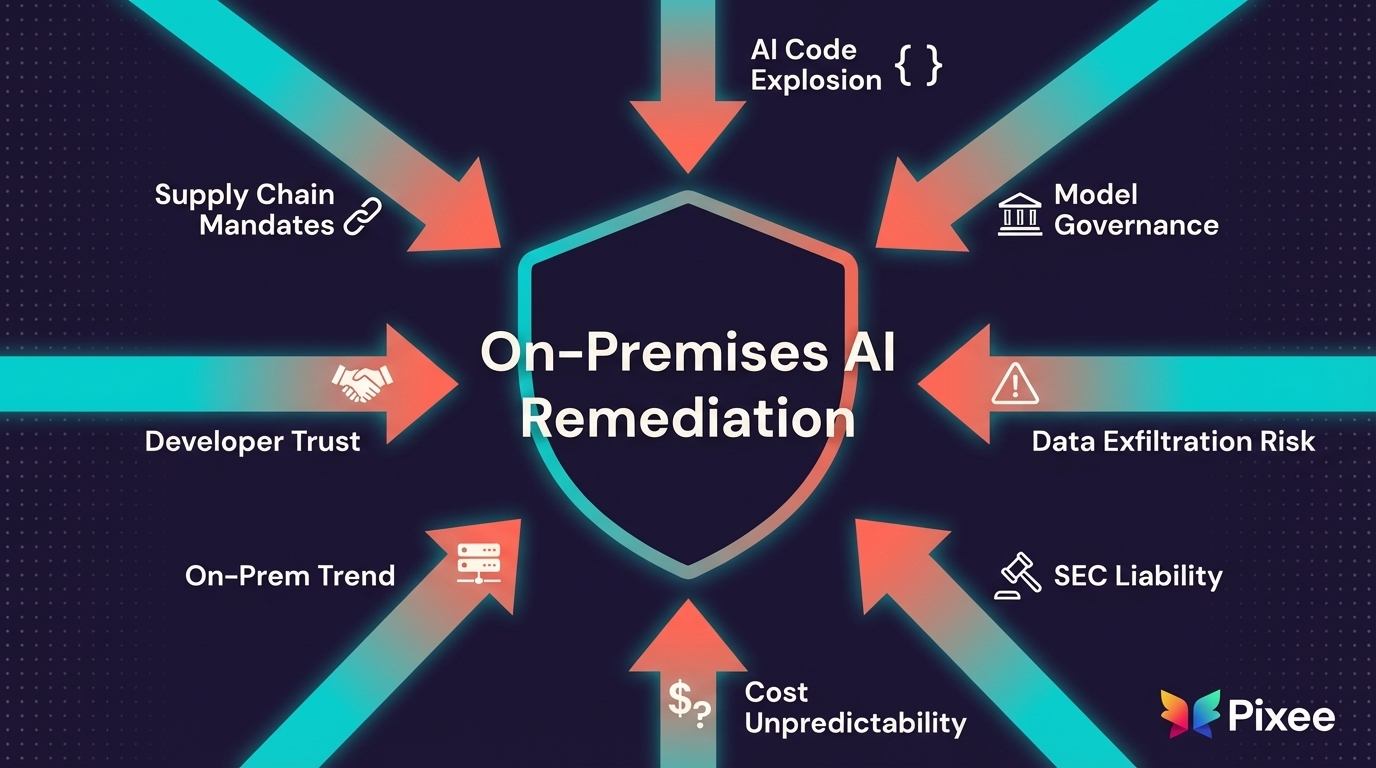
AI-powered development is accelerating while governance requirements tighten. Your developers write code 2-5x faster with AI assistants. Your compliance team demands greater accountability for every line shipped.
You're caught in the middle: you can't send proprietary code to vendor clouds for AI analysis, but you can't skip AI-powered remediation while competitors pull ahead.
On-premises AI security and remediation have shifted from "nice to have" to "strategic imperative" for regulated enterprises. Here are the eight forces driving this urgent shift toward sovereign AI deployment.
1. The AI-Generated Code Explosion
Copilots and AI coding assistants have accelerated code production dramatically. Studies show 25-70% productivity gains depending on the task. But AI-generated code introduces inconsistent security patterns at the same velocity.
The attack surface expands faster than manual remediation can respond.
This is the force multiplier behind everything else. When your developers produce code 2-5x faster, your remediation capacity needs to scale accordingly. Otherwise, your backlog compounds.
2. Model Governance Mandates
Boards now require that AI models analyzing proprietary code remain within customer infrastructure. "No code to vendor clouds" has become standard policy at Fortune 500 enterprises implementing AI governance frameworks.
This isn't paranoia. It's pragmatic risk management. Your competitive advantage lives in your codebase. Sending it to external AI infrastructure creates unacceptable exposure. The AI governance requirement is clear: if AI touches your code, that AI runs on your infrastructure with full data sovereignty controls.
3. Cloud-AI Data Exfiltration Risk
The risk isn't hypothetical. It's documented.
CamoLeak (CVSS 9.6) demonstrated architectural data exfiltration from cloud AI coding tools. When your code flows through vendor AI infrastructure, vendor breaches become your regulatory disclosure.
For regulated enterprises, this creates a binary choice: accept the cloud AI risks with external processing, or adopt on-premises AI security where you bring the AI to your code instead of sending your code to the AI.
4. The SEC Liability Shift
The SolarWinds CISO charged with fraud ($18M in fines) established a new precedent: personal liability for vendor security failures. Security leaders now face career-ending consequences for preventable breaches.
This changes everything about cloud AI adoption. When you're personally liable for vendor security failures, "vendor X had a breach" stops being an acceptable explanation. The architectural decision becomes a personal risk decision.
5. Cloud Cost Unpredictability
Consumption-based AI pricing creates CFO anxiety. Token costs fluctuate unpredictably. When you can't forecast your security automation costs, budget planning becomes impossible.
Enterprises demand transparent, controllable infrastructure costs. On-premises deployment with customer-controlled compute eliminates the consumption unpredictability that makes cloud AI financially untenable for large-scale remediation.
6. The On-Premises Compute Trend
Security infrastructure has been migrating back to customer control for a decade.
Identity management moved from SaaS back to on-premises deployment. Secrets management followed. Key management systems now run inside customer infrastructure as standard practice.
AI remediation and security automation follow the same trajectory. The pattern is clear: the more sensitive the data, the stronger the pull toward customer-controlled, on-premises AI security infrastructure.
7. The Developer Trust Crisis
Scanner-generated fixes see 3-20% acceptance rates. When 80-97% of automated suggestions get rejected, the automation isn't working. Developers have learned through painful experience that generic AI-generated fixes don't match their codebase patterns, don't respect their architectural decisions, and often introduce new problems.
Rebuilding developer trust requires fixes that understand context: your code conventions, your frameworks, your architectural patterns. That level of context-awareness requires deep integration with your codebase. Cloud tools can't achieve this without the code leaving your perimeter.
8. Supply Chain Compliance Mandates
Executive Order 14028 mandates SBOM for federal procurement. SolarWinds and Log4j exposed third-party dependencies (70-90% of enterprise code) as the largest unmanaged attack surface.
Supply chain compliance is now a procurement requirement. Demonstrating compliance requires audit-grade evidence of your remediation process. That evidence needs to live in your infrastructure, under your control, with your audit trail.
These Forces Compound
These eight forces aren't independent. They compound.
AI accelerates code production while AI governance tightens control. SEC liability raises personal stakes while cloud costs become unpredictable. Developer trust erodes while compliance mandates expand.
The result: on-premises AI security architecture becomes the only viable path forward for regulated enterprises. Not because cloud AI doesn't work, but because governance, liability, and trust constraints make cloud AI architecturally incompatible with regulated enterprise security requirements.

The Path Forward
Your Board wants AI. Your Risk Committee blocked cloud tools. This doesn't have to be a stalemate.
The answer is architectural: bring the AI to your code instead of sending your code to the AI. On-premises AI security deployment with customer-controlled models (BYOM security) resolves the tension. Your Board gets AI-powered remediation. Your Risk Committee gets complete data sovereignty and regulatory compliance.

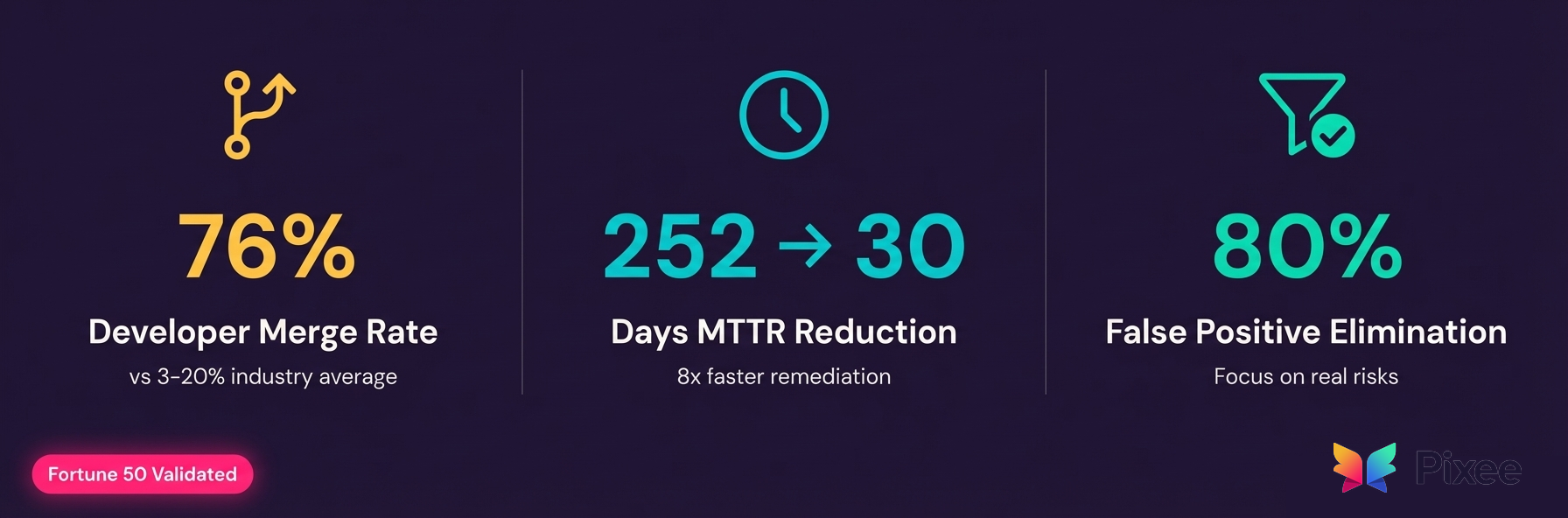
Fortune 50 financial institutions have validated this on-premises AI security architecture with 76% developer merge rates, MTTR reduction from 252 days to under 30 days, and 80% false positive elimination—all while maintaining absolute data sovereignty.
The question isn't whether on-premises AI remediation is viable for regulated enterprise security. It's whether you'll adopt it before your competitors do.
Ready to explore on-premises AI remediation for your organization? [Talk to our team about sovereign deployment options.]
Related Resources